Staying Long After I’m Gone
A life spent leaving the body becomes a search for the self that stayed behind.
By Swati Sudarsan
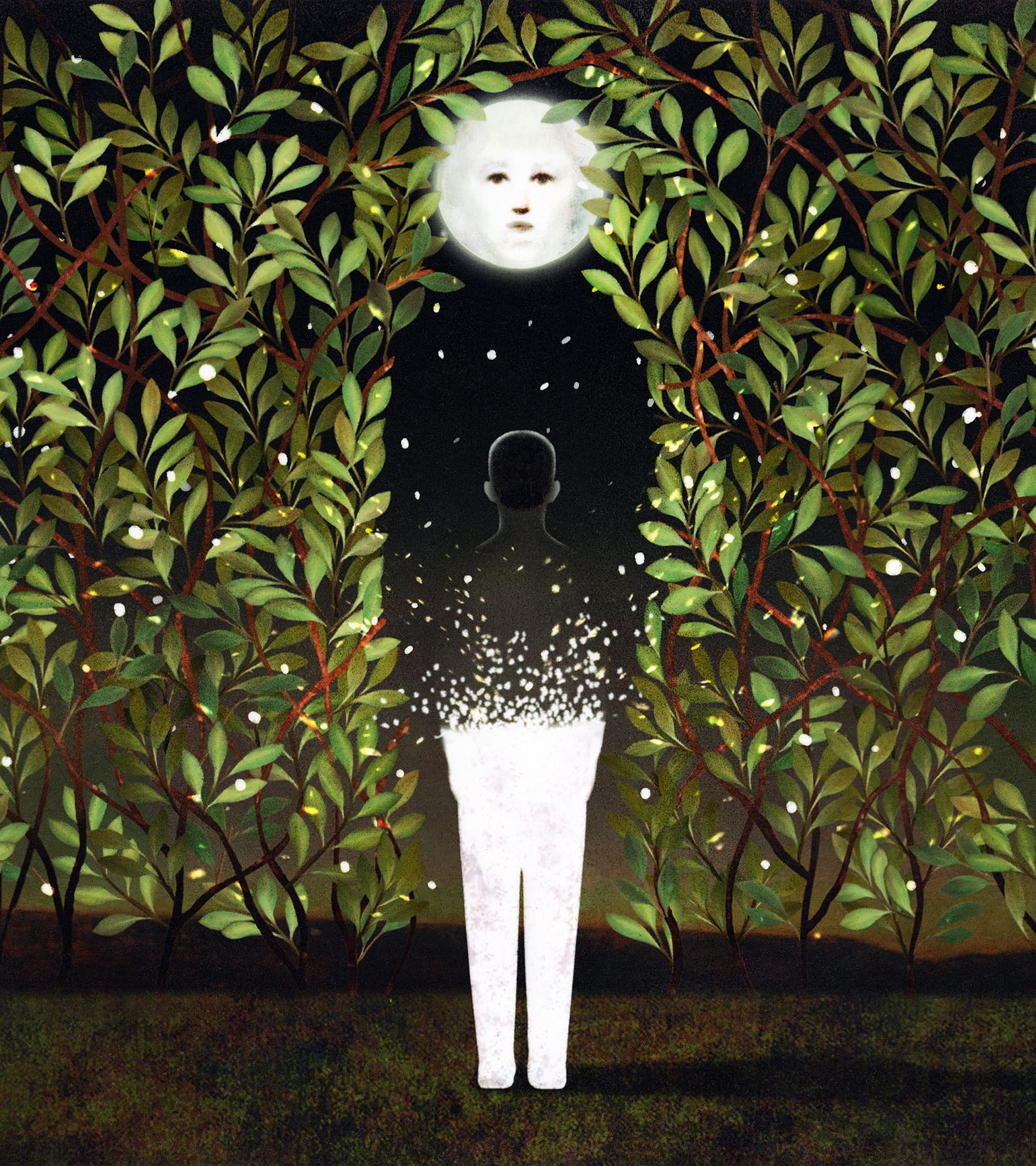
Illustration by Aldo Jarillo
Published
This article appears in our Out of Body issue, on stands now. Order your copy here or visit our Instagram for the latest updates in stockists.
I remember the first time I left my body. I was not yet twenty-one, in one of those college apartments considered campus premier but resembling a metal shoebox. I departed at approximately 11:32 PM and gently landed on the ceiling seconds later. I perched politely above myself, as if I were a box office attendee of a gruesome live show. My view was suboptimal, with most of the action obscured by my own body. First, I was on top, stiff despite being throttled about. Later, I was pinned down to the mattress. Better than the view was the audio, of which I caught every word. Sometimes, even now, it plays eerily over my shoulder, in his voice. “You bitch. You never give me what I want. Now I’m going to take it.”
Growing up, we had something called Laundry Room Time. It happened when you brought my mother news she didn’t want to hear, which was an easy task to accomplish. In fact, we were so skilled at this endeavor that Laundry Room Time became a daily occurrence, taking on the predictable choreography of a ritual. First, there was preparation and prayer to deliver the news. I showed my four-year-old brother how to clasp his hands before telling my mother he had snipped his teacher’s coat and his own eyelashes at daycare. I clasped my own together before sharing that I was ready to quit dance. After that, there was always the option to run, but our house was built in a circle, so you would be trapped in the end. It was best to be brave, face it head-on. Whimpering, wailing, and tears only exacerbated what happened in the bathroom.
Once a series of beatings had been imparted, you were shipped off to the final stage—the laundry room. There, you were seated on the dryer, with the lights turned off. You had to wait for an unknown period of time, during which the dull throbbing of your body would pair lethally with boredom. This was how I learned to let my mind wander free from my body until I was released for dinner.
I never connected Laundry Room Time with my history of assault until my therapist revealed the thread between them, as if unveiling the secret to an appalling magic trick. “Dissociation was a skill you developed as a child. You became virtuosic, but now it is maladaptive." Our sessions had been dry until recently, and I wondered why I was paying to tell her about banal friend drama or the state of my cat’s dandruff. I fantasized about drafting a “I quit” email, yet something held me back. Perhaps it was the faint blinking of some internal wisdom. My body was preparing to fail me soon, and it knew that I would need her.
When it happened, it was without drama. I was in a strange period of my life. I had left my husband, and was finding my footing in life. I still worked as an epidemiologist, communing with data about people’s bodies, but rarely with the people themselves. I planned to leave the field for something more embodied, something to do with art-making, but I learned that when you change your life, you must do so in small steps. I wanted to be a pleasure-seeking creature, but my body’s wiring was not yet acclimated to such a foreign feeling. I was in the arms of an interim lover when I left. I was there, and then I wasn’t. There. Not there. When I came back, I crashed into my full awareness. My whole body hurt, and I cried torrentially. From shame. From fear. From grief. I knew what was next. When he left me, I felt nothing.
I had always learned of transcendence as a desirable, delicious phenomenon. To leave your body was an indulgence, a form of therapy. To transcend was to glimpse a wider view of consciousness, to commune with the divine. Yet when I transcended, it was something else: Disastrous. Derelict. My therapist used D words, too. “Dissociative amnesia,” she said. “Depersonalization,” I told her how I felt Dumb As Fuck. “My brain shuts down,” I told her. “I don’t even know how to say yes or no.” She nodded knowingly. “That’s the freeze response. Your brain is playing Dead.”
As I practiced somatic healing, qi-gong, and “mindful deflection” (as one therapist recommended), I was promised my symptoms could improve with time. I was also warned that I might feel unstable in the beginning. Indeed, my introduction to the deathly swamp of my own emotions was harrowing. The protective membrane between me and my feelings was shorn in half.
Memories I had left behind on the ceilings of college classrooms, high school events, and my home in elementary school, re-entered my body, mixing and blending with each other until the pain became sticky and amorphous and interminable. There was no separation of “I” from the pain, the way a fire takes over the object it burns until they are one and the same. I became lost inside a maze of amalgamated memory, where the present melted away. There was only the iron curtain of the past, which showed me cruelly everything I had ever suppressed. Yet, the curtain yielded only to blackness. I could find no meaning behind it.
At some point, I wondered how it would feel to die. Yet, I was some hardened creature that was impossible to kill off. A cockroach relegated to the dark swamp of sorrow for eternity. During this time, I went on dates callously, for a small hit of dopamine that could fast-track me to the next day. I just wanted time to move forward, that felt like the only pleasure available to me, but then I came home from one such date with no memory. Over the course of the next day, the right side of my face swelled to the size of a tangerine. In a stupor, I told my boss at work, “I think I might have been assaulted?” He looked at me horrified and asked if I needed to go home. “No,” I said. “That seems extreme.”
It seemed ludicrous that work should go on during this phase of my life, yet it did. I was sent on a site visit to Uganda, which felt pleasantly far away. I could pretend I was someone else for the 12 days I was there, someone with an integrated self and deeply regulated emotions. In Uganda, I was cordial and gallant, well-mannered and graceful. I was the uncanny, utopian version of myself, conducting site visits across various towns, checking if they were collecting data according to protocol. On one such visit, our van hit standstill traffic on the way home. I was stuffed into the middle seat, my leg falling asleep as the afternoon bled into late evening.
As the sun softened into a hazy pink blur on the horizon, my coworkers grew quiet, dozing off as the sweet release of darkness took hold. I stared out the window, toward the grapefruit pink sun, and felt my leaden body release from its wedging within the van. I expanded into the endlessness of the fast-arriving night, and I saw not just myself, but the world from above. I was outside myself, but this time, I was incredibly lucid. All those therapy techniques taught me I needed to be inside my body if I was ever to heal, but here was a version of myself that could exist from above expansively, mutably, with sharpness and clarity. This was the self of epiphany. I said the realization aloud to myself so the body below could hear it. “You are here and everywhere. Even when you’re gone, you’ll find your way back.” And like a god from above, I saw that I was indeed impossible to kill off.