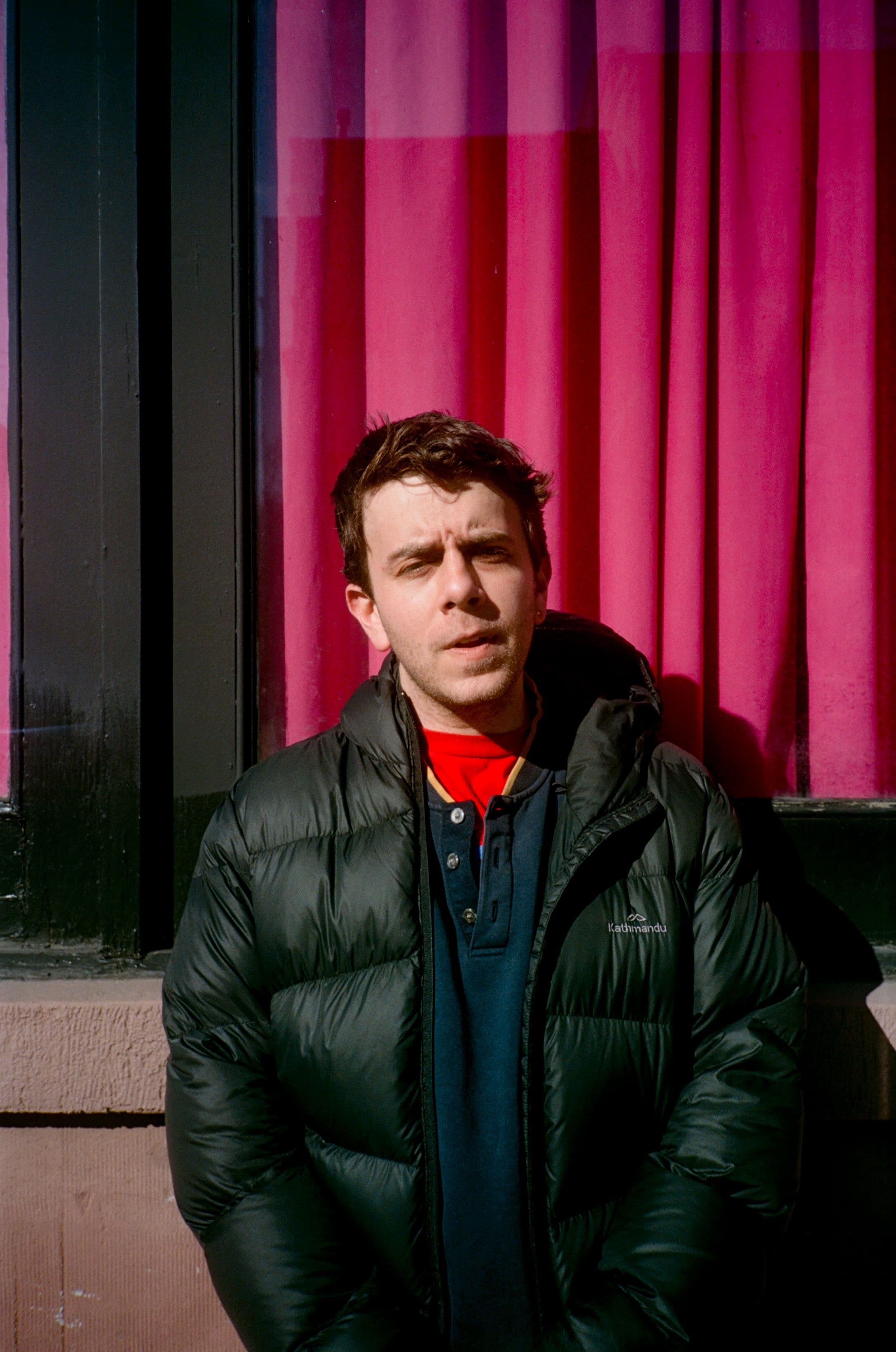
Lina Abascal on Following a Meme All the Way to Brazil
Inside Come to Brasil, a documentary about the fans who meant what they said.
By Gutes Guterman
Photos by The Holy Mountain
Published
For years, "come to Brazil" has been the internet's most reliable plea—a love letter dropped into pop stars' comment sections so often it curdled into meme status. A shorthand for devotion with a wink attached. Director Lina Abascal had been typing some version of it herself for over a decade, mostly as a joke. Turns out the joke had a lot more going on underneath it.
Start with the numbers. Brazil has roughly 220 million people and more than 30 million paid music-streaming subscribers. Spotify has ranked it among the top five countries on earth for building and sharing playlists. And yet, major tours still route around South America like it's optional. The math doesn't add up, especially when you're one of the fans stuck on the wrong side of it.
Come to Brasil, a new short documentary, follows four of them. Thaisa runs with an all-women Beyoncé-inspired carnival cover group. Júnnior's been a Madonna devotee since before the internet existed, and unlike most fans in the film, has the means to fly out and catch her abroad. Netto is a fixture of Rio's ballroom scene, sewing Gaga-inspired costumes for it. Bruno camped outside Estádio Olímpico Nilton Santos for the Eras Tour, because when someone does come to Brazil, you show up early.
The film was shot in four days after months of prep and was cut from over 30 hours of footage. It skips the sit-down interview format for something looser: time spent just living alongside each subject, staged bits where they channel their idol (Júnnior vogueing, Bruno flashing his friendship bracelets), and a MacBook-style interface, designed by Noah Greene, that drops you straight into a fan's browser mid-spiral.
The argument underneath all of it: this is infrastructure. A subculture fans built themselves because no one else was going to build it for them. And they wanted to be heard.
Come to Brasil is now streaming on Rolling Stone's YouTube channel and on Documentary+. Below, Lina talks about tracking down her four subjects, dodging the clichés that usually define pop fandom on screen, and turning a decade-old inside joke into a film.
How did the idea for Come to Brasil first take shape, and what made you realize the phrase could sustain a documentary?
I have been commenting “come to Brazil” in a silly way for over a decade. To me, as an American lifelong internet girlie, it was just the ultimate symbol of I love you or I miss you. But once I began to dig into it more, I realized the meaning and how it was rooted in a true lack of access to live music, and I realized how this was actually reflective of serious geopolitics, economics, and infrastructure. It actually is that deep.
While I have been writing about music and culture for 15 years, I only began making films 3 years ago. I can’t remember the exact moment when Come to Brasil occurred to me. It was just a nugget in my brain and once I made Stud Country, I began to think about how I wanted this to be my next film topic.
I knew it would be more involved and more expensive, as it involves international travel, but I saw that no one had ever made a documentary about it, not even old school VICE.
As a journalist, I was constantly getting scooped or beat to a story by someone more established or in-house at a magazine with less logistical loopholes. My approach to filmmaking has been a “start tomorrow” attitude when I get an idea that is a first of its kind.
I told Gia Rigoli of Discorida about the idea the first time we met in May 2025 and then in June 2025, when I won an award at the Tribeca Film Festival and was interviewed on camera, I mentioned the phrase as a hint at the next thing I was doing. This was before anything was set up. No casting. No funding. I guess I just knew one way or another it would happen.
What was the process of finding Thaisa, Netto, Júnnior, and Bruno, and what made you choose these four fans?
First, we put out a flyer online looking for people to submit for casting, but it didn’t work as well as I had hoped. For my last film, that was all it took, but it was also a smaller possible network of characters as it was attendees of one singular dance event in LA.
After realizing that wasn’t working, our Brazil-based producer, Tadeu Bijos, brought on researcher Duda Carvalhaes, with whom he had worked before. I had these fantasy character archetypes in my head that were not the “typical” or obvious fandom characters. I wanted an older man. I wanted someone in a cover band. I wanted a drag performer. I wanted someone who had never seen their artist of choice. Duda got to work finding people online, I don’t even fully understand the magic she worked. She made me presentations of 50 possible subjects and I whittled it down, gave notes, and continued to review more options until we interviewed about 20 finalists before distilling it to the final four.
I chose Thaisa, Netto, Júnnior, and Bruno because I really liked how each of them connected to their star of choice. Thaisa is part of a cover band unique to Brazilian carnival culture, made up entirely of women. Júnnior represents an older generation who was a fan before the internet. He also is from a socioeconomic class that allows him to travel internationally to see Madonna and see her when she does come to Brazil, giving him a different perspective. Netto is a star of Rio ballroom culture and designs Gaga-inspired costuming for these events which was beyond my wildest dreams. Bruno’s camping story also really stood out to me.
Because so much of fandom happens online, how did you translate that experience into something visually engaging on film?
I think this is really where the film is unexpected. It’s an internet phenomenon but rooted in human experiences anyone can relate to. Hope, risk, frustration, community. I wanted it to feel very human and not just internet or meme-y, but I knew it also needed an internet culture angle and an aesthetic way to bring in those archival materials.
The film utilizes a MacBook-style interface with a first-person perspective designed by Noah Greene to show fan-generated footage in a way fans experience it, in a million tabs and notifications going frantic on their phones and computers.
In the MacBook sequences, the expert talking heads “FaceTime” in to speak, which I thought was a fun device to bring in additional subjects that we didn’t interview in person because they were sourced later and were located in other cities.
It was very important to cinematographer Gemma Doll-Grossman and me to have a very lived-in, verite feeling. We did not just want sit-down interviews and screenshots of Twitter like a Netflix documentary—to me, those feel not as artful (sorry! No shade).
To achieve this, we filmed a combination of seated interviews with the subjects, fly-on-the-wall footage of them in their daily lives, and staged, fourth-wall-breaking footage of each subject doing a dance move or action inspired by their idol. Júnnior poses like Madonna’s Vogue, Bruno shows off his Taylor friendship bracelets, Netto poses in the mirror. We layered an ambient score by Peter Colombo in those moments to make them dream-like.
How did you earn your subjects’ trust and avoid reproducing the mocking or sensationalized way fans are often portrayed?
I met with them multiple times over video chat before we were there in person. In person, we had a full 12-hour day with each subject, even if they are each featured in the final film for about 5 minutes of footage. We had meals together and hung out in between filming and it felt very friendly and fun.
I tried my best to explain my vision and intention with the film so they felt understood and safe. I also shared my other short documentary, Stud Country, which I believe handles sensitive subject matters with care so I would like to think they saw my style and approach.
The film is also made almost entirely by women and many Brazilian filmmakers, so I don’t think they felt it was a voyeuristic approach. Even spelling Brazil the Portuguese way, Brasil, is in honor and tribute to the Portuguese-speaking Brazilian fans.
What was the most difficult scene or moment to capture, either logistically or emotionally?
Logistically, probably the Gaga concert just due to the size of the crowd.
Emotionally, none of it was difficult, but a lot of it was very moving. I admire these people so much and think they are such a beautiful representation of faith, community, and perseverance.
Did the story change significantly during filming or in the edit from what you initially imagined?
When we shot the core of this film in December 2024, the Lady Gaga concert had not been announced, so I had no plan for inclusion of that, let alone it being the emotional ending. Once that was announced, I knew we needed to capture it, especially because it was such an impactful resolution to Netto’s storyline about refusing to see Gaga until she came to Brazil.
The bittersweet ending, which points out that the pop stars aren’t the entire point, but are representative of community and shared experience, came together in the edit. Dri Sommer and I worked for half a year or longer piecing together over 30 hours of footage into 20 minutes, and the line that became the final line of the film is something we had lost in an offhand interview and then uncovered much later. It was meant to be and only possible through not rushing.
What advice would you give someone with a documentary idea who does not know how to begin turning it into an actual film?
I am very new to this, but for my first film, I picked something local that I had access to and paid for it entirely myself. This way I was not beholden to anyone else, and I didn’t expect anyone to pay for me to do something for the first time. That film was actually an expansion of an article I had written, so perhaps writing it out as a story might help some people. Making a mood board may help others, a photo series if that’s your usual medium, but I think for a documentary, actually getting out there and finding information and subjects is how you’re going to see if this has legs.
I am such a believer in just following the story and your gut. I am fully delusional and recommend other artists to be too.
At what point did you know you had enough access—and a strong enough story—to move forward with production?
Once we locked our four core characters around Fall 2025, I knew we could make something beautiful with them. I knew how long independent filmmaking can take because of resources and it not being anyone’s full-time job, so I wanted to get to Brazil ASAP, so we ended up going within two months. The film didn’t actually come out until 18 months later.
How did you assemble the team and secure the support needed to make the film? Which collaborators were essential early on?
Discordia, the primary production company, was on board with me from before I even had a deck. They immediately saw the vision and wanted to be involved. I connected with them because one of the cofounders followed me on Instagram, and I cold-DM'd her.
From there, they suggested cinematographers from their network that may be a fit and I reviewed them and interviewed them until I selected Gemma Doll-Grossman. I really loved her eye and how she spoke about collaboration when we spoke. We met over Chinese food and she brought a dozen coffee table books from the library and we looked at composition and color of photos from Brazil over the last half century or so for inspiration.
Tadeu Bijos, who was our Brazil-based producer and his production company Cosmocine, are friends of Discordia; they all went to film school at Chapman together. He was critical to operating like locals on the ground. He also brought on Duda Carvalhaes, our researcher, who helped me cast the subjects.
Was there anything about filming in Brazil or working across different locations and fan communities that required you to rethink your original production plan?
Honestly, no. I was amazed by how seamless everything went thanks to working with a local production partner. We prepped for months and went down for 10 days, even though we only shot for 4, to ensure we could be flexible with our subject’s availability.
For the pickup day at the infamous Lady Gaga Copacabana beach concert, we, of course, couldn’t have the full film crew profile among 2.5 million people, so we ended up using a second-unit iPhone DP. I hadn’t planned for the film to include that footage, but it was what allowed us to get intimate proximity to Netto and their friends and helped us stay safe and nimble.
Is there one scene that, to you, captures what the film is ultimately trying to say about fandom?
To me it’s the final scene with Netto, moving between being one of 2.5 million fans in a crowd to dancing with one friend on what feels like an almost fantastical, ethereal dancefloor (it was actually just on the earlier side at a pop music dance night). I think it encapsulates the multitudes of the fandom experience, and I always shed a tear when I hear her final line.