My father immigrated to America from the Philippines exactly 50 years ago. His life's work proves that immigrants are essential, especially in my home state of Texas. So why did I still struggle to feel at home?
Published
Let’s set the scene. My grandmother, Lola, spent the day cooking a feast of our favorite Filipino hits—Sarciadong Baka, Bangus, Pancit, Lumpia—all of which included what felt like gallons of garlic and patis (fish sauce). Although delicious, you had better remember to shut your bedroom door or your clothes would wreak for days.
The next morning, I got dressed for school and could smell that very meal on my school uniform, my hair, my backpack—there was no getting rid of it. I tried spraying perfume, fluffing my clothes in the dryer, running around outside. To much frustration and panic, nothing worked. It was senior year, so you can imagine this meant my life was over (for the day). When I arrived at school, I asked no less than ten people if they could smell the garlic on me. Some said “yes,” some said “no.” I just thought they were being nice. I decided to go buy a sweatshirt in our student store to mask the embarrassment smell. Don’t worry, I survived to tell the tale.
I think of this day often. It reminds me of this iconic scene in the show Pen15, when Maya, a 13-year-old Asian girl, looks in the mirror and tries to change the shape of her eyes in order to look like her white friends. When I first watched this scene, I had a visceral reaction. It felt like the Sarciadong incident all over again. Shame, disdain, and lack of acceptance of myself and from others. Growing up in Dallas private schools where no more than 10% of my grade were people of color, I hated being different. Yes, I made some of my best friends to this day, but it was something that quietly weighed on me and I was painfully aware of in ways others did not have to be. Because I am half white and look racially ambiguous, I never felt like I was allowed to feel a particular way or often felt like maybe I was overly sensitive to situations. Some days I felt too brown, some days I didn’t feel brown enough. Sometimes, it was just right.
I went to two private schools in my adolescent years and both had brochures that included pictures of the actual students. I was in both. Some might say it was because I was a good student who was involved in multiple extra curriculars—because not to brag, I was—but it was hard not to feel like a token of diversity. The brochure might as well have screamed “Look! People of color go here!” And although I wouldn’t change my experience in the slightest, it was all so confusing. I know my siblings and my dad felt this uneasiness too. My dad always attempted to blend in. At one point, we found tapes in his car that helped him practice how to get rid of his Filipino accent. Both of my siblings left Texas after they graduated high school and I followed suit. Leaving made things clearer: it was the world around us that never felt safe enough to embrace that part of ourselves. This isn’t one particular person’s fault. This is all our fault. All of us.
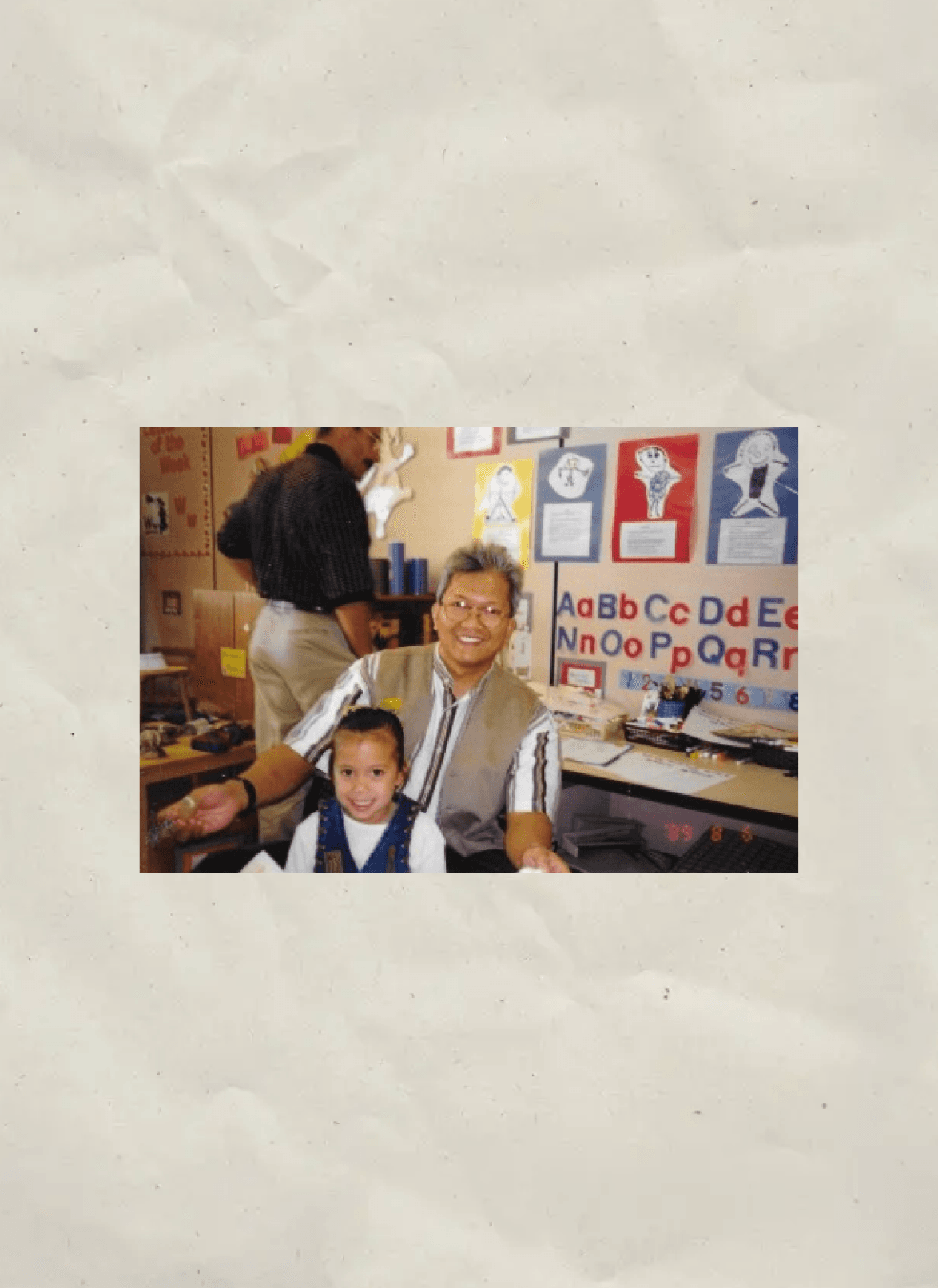
My father immigrated to America from the Philippines exactly 50 years ago. He lived in a house—which was more like a hut—with 4 siblings, one of which didn’t survive due to dysentery. From the moment he spotted a man in a white coat, he spent his young life aiming to come to America and live out his dream of becoming a doctor for himself, his family, and his future family. He is the epitome of the American Dream—a physician who served as a medical resident on a U.S. Air Force base in the Philippines and has dedicated his career to caring for and serving the American people. His work and sacrifice are a reminder that immigrants have always been essential to building and sustaining this country and its economy. Especially in my home state of Texas, they fuel the working class. Knowing this, the way immigrants and actual citizens are being targeted, tortured, and picked apart today is not just wrong—it is a deep betrayal of the very people who give so much and ask for so little in return.
To think if my dad were to make that same decision today—to build the life he often dreamed of—and be treated so inhumanely as a result of following his dream rocks me to my very core. It makes me sick to think about all the “what ifs.” My family would not exist. I would not exist.
We Facetimed on the day ICE murdered Alex Pretti, both crying, trying to understand how, after all this time it can feel like we’ve moved backward. Why am I apologizing to my father for simply existing? Why should I have to warn him to carry his passport with him everywhere he goes?
I’m sharing all of this, not for pity, but because I am scared, angry, and honestly, tired of being tolerable. You should be too. What is happening in our country is a personal attack on humanity, therefore, it is an attack on you. Please don’t look away because it makes you uncomfortable or because it’s “too sad.” Please don’t let the guilt of having voted for a monster paralyze you. Allow yourself to feel whatever you need to let it move you toward action and compassion. Check on the people of color in your life. And if there aren’t many, please ask yourself why. Be kinder, softer, curious, and celebrate what makes us a richer nation—diversity. I know I will be doing what I can for the girl who smelled like garlic.