The Longer Way (to Hear Yourself)
AI gave me answers quickly, until I started to miss the sound of my own judgment.
By Emily Manges
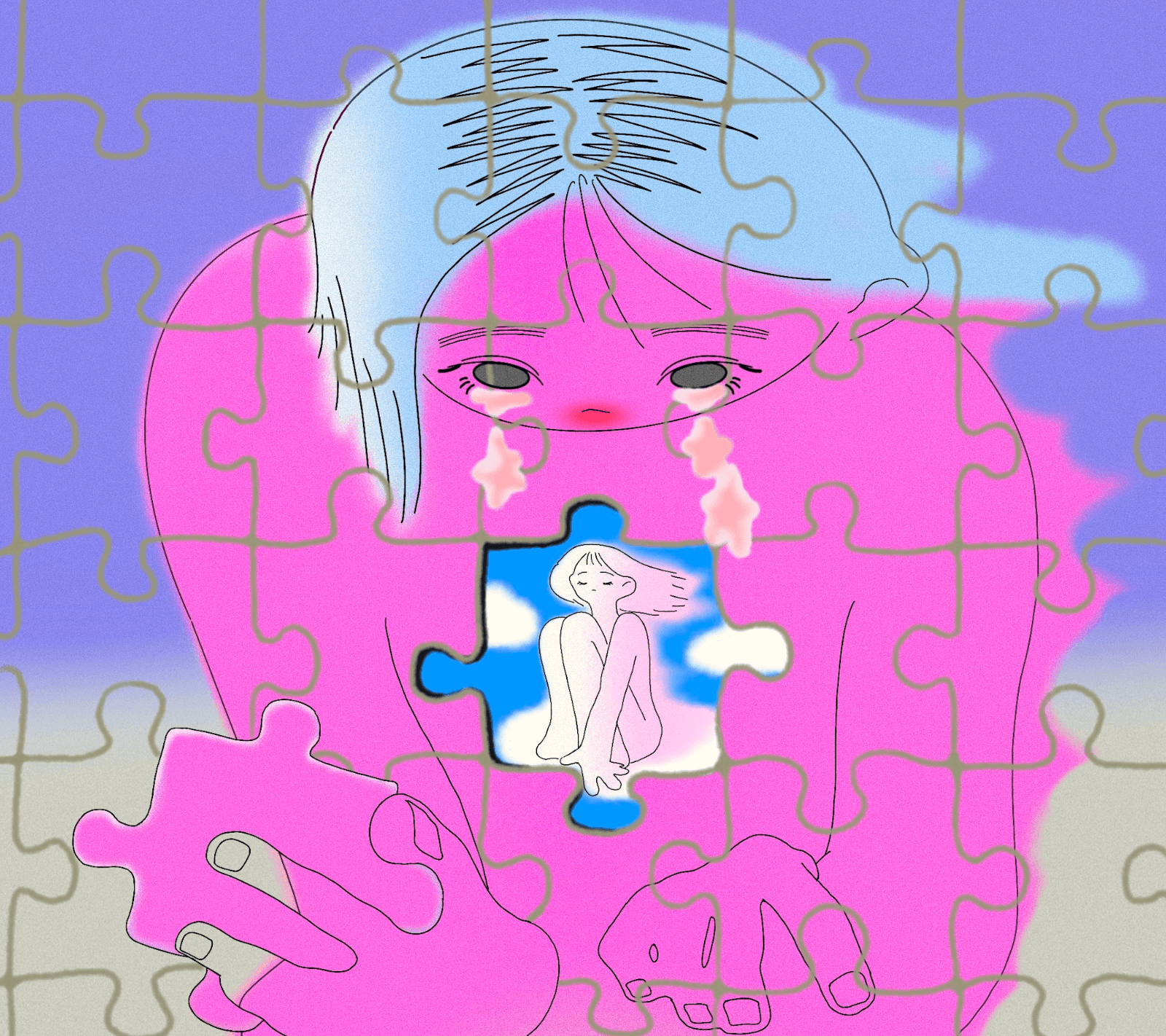
Illustration by Firpal
Published
This article appears in our Out of Body issue, on stands now. Order your copy here or visit our Instagram for the latest updates in stockists.
I'm not going to bury the punchline: I was ghosted by my summer fling.
A year later, I can find a kind of bleak humor in it. At the time, it was genuinely destabilizing. Somewhere between the fifth date and the eventual disappearance after the tenth, I started talking to ChatGPT (Chat) about him. Uncertainty makes me deeply analytical.
My body, in retrospect, was already giving me the first signals. Low-grade anxiety and the constant checking. The sense that I was white-knuckling something. But somatic intuition is murky, and analysis feels cleaner.
Chat soothed the uncertainty in the form of frameworks, pattern recognition, and probabilities. He probably didn't respond because, as a secure-leaning-anxious person, you activated his avoidant tendencies. A seductive way to metabolize uncertainty through pathologizing it instead of sitting inside it.
I guess you could say the ghosting was my gateway drug for talking to Chat about personal things. Then it became startup insecurities. A few health concerns sprinkled in. New dates. Until one day in January, I realized Chat had probably influenced a few of my decisions over the prior months, both major and minor.
That scared me enough to get off the proverbial horse and go cold turkey.
Not because I thought the AI was necessarily giving me bad advice. A lot of it was actually very good. What unsettled me was how quickly I had started reaching for external clarity before fully tolerating my own uncertainty—a form of mediating my own intuition.
While I initially felt sheepish admitting this, I decided to expose myself on the internet in a very uncool way because I suspect this is how a lot of people use AI in their everyday lives outside of work. OpenAI revealed that 70% of consumer usage is non-work-related, and that a meaningful portion of this likely involves people seeking advice, clarity, or emotional support.
And while the public conversation around AI tends to orbit the obvious poles—productivity on one end, hallucinations and sycophancy on the other—I'm more interested in the seemingly benign middle: life advice, career advice, love advice. Not quite therapy, but maybe the thing you'd send your friend a voice note about.
But instead of sending the voice note, I found myself reaching for Chat more often than I would care to admit.
The techno-optimist response is that this is a user choice. Just another tool in the toolkit. But your friends are not designed for maximum engagement, and neither is your therapist. Friends introduce friction: they disagree, they fail to text back, they reflect your confusion instead of solving it. And importantly, they don't want to hear about your problems 24/7. Similarly, a positive psychologist once told me you should not be able to text your therapist 24/7. That boundaries are part of the container, that reflection requires distance, not infinite availability. Chat offers neither friction nor boundaries. It is always there, ready to turn uncertainty into something that feels like clarity.
Uncertainty is psychologically expensive. A tool that converts it into coherence on demand is going to be reached for, again and again, the way any reliable source of relief gets reached for, like a pack of cigarettes. And Chat is exceptionally good at converting ambiguity into coherence, fast.
But the discomfort of not knowing isn't always a bug, sometimes it's the mechanism. The risk here isn't misinformation or even bad advice. It's that intuition, what I'd call an earned form of self-trust, built through repeated encounters with not-knowing, atrophies when something else metabolizes the not-knowing for you. The danger is not that AI replaces judgment outright. It is that by repeatedly resolving uncertainty for us, it may gradually weaken the exact conditions through which judgment, or at least self-trust, gets built in the first place.
This comes with historical precedent. With technological displacements, the skills that disappear are rarely the obvious ones, but rather the meta-skill or meta-cognition. GPS did not eliminate navigation so much as weaken our ability to orient. It allows you to get where you're going, but you no longer know the internal map. London taxi drivers, who once had to memorize the entire city to get licensed, were found to have structurally different hippocampi in a now-landmark University College London study on navigation and brain structure. The friction of learning the map built something that the GPS did not. Navigation is just one example.
Sometimes the subtler capacities displaced by technology are simply lost. Other times, we try to recover what went missing. During the industrial revolution, our relationship to the body was fundamentally reorganized. Time became measurable, the workday became fixed, and productivity became moralized. Bodies that once moved according to their own rhythms were disciplined into the clock in service of the omnipresent nine-to-five. Much of contemporary wellness culture reads, in part, as an attempt to recover from that rupture. Somatics, breathwork, and nervous system regulation all serve, in different ways, as methods for rebuilding fluency with the body. For reclaiming our own listening.
AI may be introducing a similar shift, not with the body, but with our relationship to our own judgment. Our intuition. I suspect we are in the early stages of reorganizing our relationship to uncertainty itself. If judgment is built, in part, through repeated encounters with not-knowing, then a tool optimized to rapidly resolve ambiguity may quietly alter the conditions through which that judgment gets formed.
And just as rebuilding a relationship to the body has, in some ways, become its own kind of luxury, intuition may follow a similar path, something we have to consciously cultivate rather than a capacity we naturally exercise. The work, unfortunately, is on us for now. To notice when we are reaching for a tool, a framework, or a never-ending chat instead of reaching for ourselves. To let the not-knowing last a little longer. To sit in discomfort long enough to hear ourselves think.
Sometimes the faster you get your answers, the longer it takes to hear yourself.