Roxane Gay and Debbie Millman Revamp The Rumpus
Roxane Gay and Debbie Millman now own The Rumpus. What does that mean for the publication’s future?
By Dolly Meckler
Photos by Emmie America
Published
When I went to college, I didn’t have a clear idea about what I wanted to study. I’ve always loved learning, and I loved school (just not math class). I decided I would pursue a degree in digital media, and when I had room in my schedule, I found myself gravitating toward Gender Studies classes.
In my sophomore year, I took a class about gender and pop culture with Professor Jennifer Maher, which opened up my world. Everything we were learning about felt radical, but real-world. Forward-thinking, yet open-minded. It was theoretical but immediately applicable to how I understood media, culture, and myself.
Over the next three years, I read essays and books by some of the great thinkers in gender and feminist theory, including Simone de Beauvoir, Judith Butler, bell hooks, Justin Vivian Bond, and Roxane Gay. I ended up taking enough classes to write a thesis on the underrepresentation of women in media, and graduated with a minor in Gender Studies.
Fifteen years later, when I was offered the chance to interview Roxane Gay for Byline, I jumped at the opportunity. Her work helped shape the way I see the world. I think about her words constantly as a woman trying to make sense of culture and identity in real time.
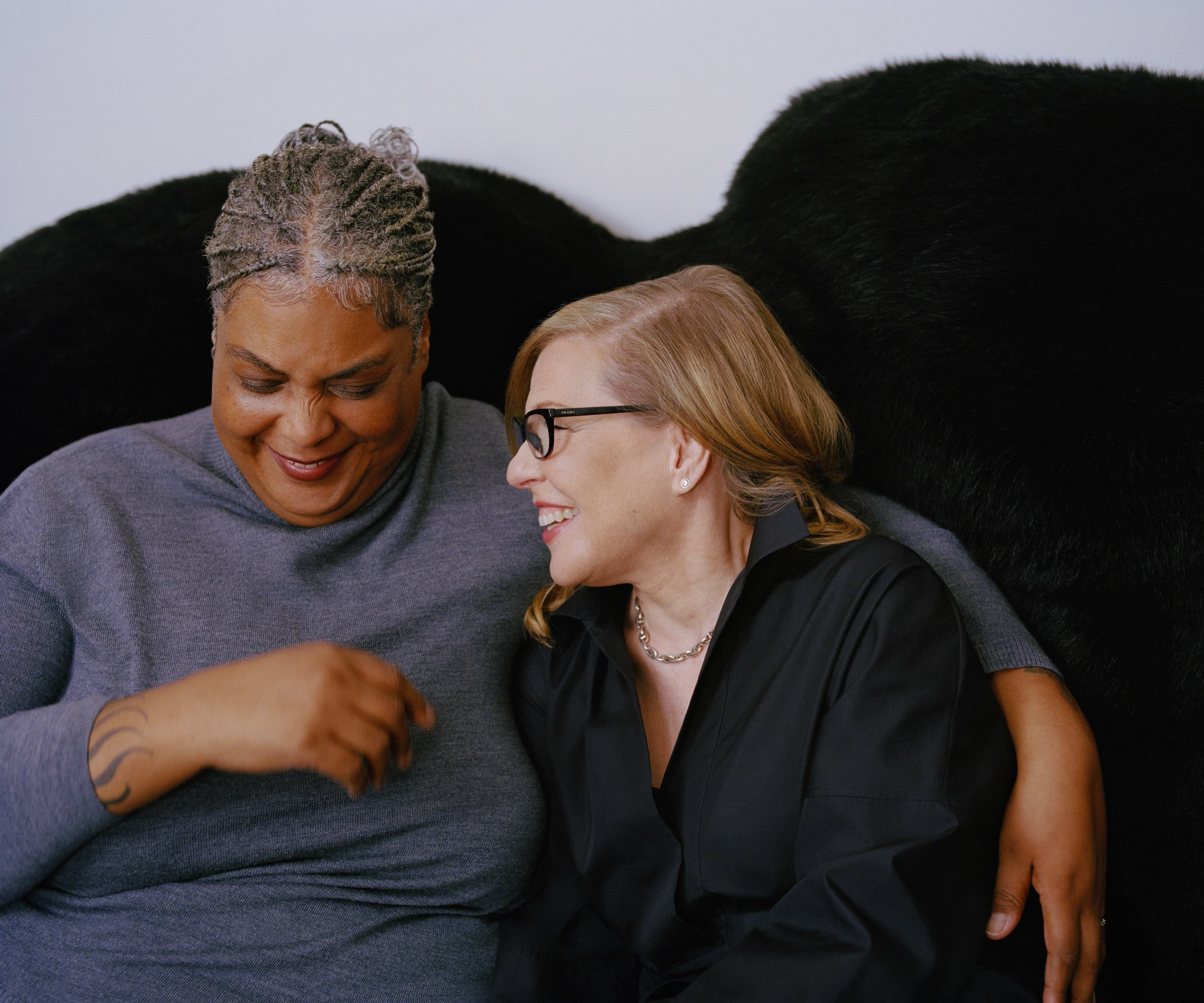
Gay and her wife, Debbie Millman, are now leading acclaimed online publication The Rumpus into its next chapter. After acquiring the beloved magazine in 2025, the two have spent the past year rethinking both its editorial vision and visual identity while honoring its independent literary roots as a home for fearless essays, fiction, poetry, criticism, and comics. They’ve redesigned the site, expanded community initiatives, and are committed to supporting writers whose work challenges cultural conversation. This relaunch feels like an act of care. A way of protecting what has always made The Rumpus so special, while making room for what it can become.
DOLLY MECKLER: Hi Roxane, it’s so nice to see you. I have to share that I studied gender studies in college, and your work, I swear, completely changed my life. My post-it copies of Bad Feminist and Hunger are so important to me. We actually met—I’m not sure if you’ll remember this — during a virtual challah bake during COVID.
ROXANE GAY: Yeah, I do remember, with our friend Tiffany Shlain.
DOLLY: Yes! So we briefly met there, but anyway, it's great to see you again.
ROXANE: That’s so funny. We talk about that challah bake all the time.
DOLLY: Do you?
ROXANE: Yeah, because, well, A) I love making challah. And, B) it was such a thoughtful thing for Tiffany to do, and sometimes it's the little things.
DOLLY: Absolutely. Those are the things that stick with you through the crazy times like COVID. Well, I want to be mindful of time, so let's get into it. You've described this as a full-circle moment. The Rumpus was one of the first places where your writing found a significant audience. You were Founding Essays Editor, and Debbie became aware of your work through The Rumpus. So I'm curious to hear from you: when the opportunity to actually own it came up, what made you say yes?
ROXANE: It was actually Debbie who made me say yes. When they first approached me, they asked if I knew anyone who would like to buy The Rumpus because the previous owner, a wonderful woman named Alyson Sinclair, was working very hard to keep the magazine running, and to continue to pay writers, and she was working multiple jobs to keep the ship afloat, and as often as the case with literary magazines, that was just too much. And so, at the time, I said, “Well, I don't really know anyone.” And then [Alyson] asked me, and I sort of said, you know, I can't buy it right now. I've got too much going on. My mom was really sick.
Then one day, we were visiting my parents and walking in their neighborhood with our dog. Debbie owns another magazine, PRINT, with four of her colleagues. She was talking about an issue they were dealing with, and I just casually mentioned, “Oh, by the way, they want me to buy The Rumpus, but I told them no.” And Debbie said, “Oh, we're buying it!” Like immediately. Then we went on a grand adventure. It did feel very full circle, because I had worked with and written for The Rumpus_—oh my god—for almost 18 years now.
DEBBIE MILLMAN: When Roxane was approached about acquiring The Rumpus, there was a chance that my partners and I would lose control of the PRINT website. Working on PRINT has been one of the most important experiences of my career, and I was heartbroken it might be over. The timing of the invitation to acquire The Rumpus felt like a gift, and I urged Roxane to consider it. She did. And a few months later, we were the proud new owners. Then, in a wonderful and unexpected turn of events, my partners at PrintMag.com and I were able to keep the publication. So now I am officially a magazine mogul (joking!).
DOLLY: When you inherit a publication with more than 15+ years of history, how do you decide what's essential to its identity? And how do you choose what has to be protected versus what should change?
DEBBIE: The redesign was an act of stewardship rather than correction. When Roxane and I acquired The Rumpus, we understood that we were not starting with a blank page. We were inheriting a publication with a long history, a devoted readership, and an editorial identity built over many years by writers, editors, and readers. Our responsibility was not to remake it in our own image, but to understand what had made it matter and create the conditions for the publication to continue to evolve.
The archive needed to become more accessible, the reading experience more coherent, and the publication’s visual presence more commensurate with the quality of the work. We’re committed to keeping The Rumpus’s risk and experimentation, its literary curiosity, its irreverence, its commitment to emerging writers, and its willingness to publish work that might be too unusual, personal, difficult, or uncategorizable for more conventional outlets. I also wanted to preserve its sense of community. The Rumpus has never felt like a publication speaking down to an audience; it feels like an ongoing conversation among people who care deeply about language and ideas.
ROXANE: We definitely wanted to honor the magazine's past, and we have a very rich archive. We didn't want to make the magazine unrecognizable, but we also want to make sure that we are demonstrating that everyone evolves–that as writers and thinkers, we evolve, and as a publication, we're evolving. In fact, we're about to launch a summer reading challenge that honors the archive and encourages people to work their way through our archives throughout the rest of the summer.
We're trying to expand the initiatives we offer: we've raised the pay we can offer our writers, and, especially with Debbie, we're going to expand our cultural coverage, going beyond what a traditional literary magazine would cover to also offer commentary.
DOLLY: I recently read a Note on Substack that said, “I've realized that good design is a form of respect for your reader's attention.” What did you want people to feel or understand about The Rumpus before they’d even read a word? Were there moments when the editorial and the design pulled in different directions? If so, how did you resolve them?
DEBBIE: Before anyone read a word, I wanted them to understand that The Rumpus was a serious literary publication with an enormous heart. It has always been intellectually ambitious, but it has also been generous, intimate, unruly, and deeply interested in voices that might not find a home elsewhere. The redesign needed to visually convey that range. I wanted it to feel authoritative without becoming institutional, contemporary without becoming fashionable, and welcoming without sanding away any of its edge.
The most important thing for me was to create a reading experience that honored the work. Good design must respect a reader’s attention, but it also must honor the writer’s labor. The typography, pacing, hierarchy, and navigation must allow room for the writing rather than compete with it.
The answer was never to force everything into sameness. We developed a system that could hold poetry, criticism, fiction, interviews, and personal essays, while allowing each form to retain its character. There was healthy debate, but it was productive, as we were all working on behalf of the publication rather than protecting an individual preference.
DOLLY: You've built a career around having such a strong point of view. Who taught you to trust your own taste?
ROXANE: Both my parents, but my mother especially, was a very opinionated woman. Knowing what you think and feel was modeled for me from a very young age. My parents always encouraged my brothers and me to be our own people, to believe what we believe in, and have good reasons for what we believe, and to be able to defend them. I was also the beneficiary of an excellent education. I went to schools that encouraged independent critical thinking. And when you are encouraged to think critically, and to develop a point of view, you actually have the space to do so.
DEBBIE: I’m not sure that any one person taught me to trust my taste. I think I learned it slowly through making things, getting things wrong, defending choices I believed in, and discovering that taste becomes more reliable when it is supported by knowledge, curiosity, and sustained attention.
I also learned that trusting your taste does not mean assuming it is infallible. It means being willing to articulate why something is working, remaining open when someone sees what you have missed, and recognizing the difference between changing your mind because you have learned something and changing it because you are afraid of disapproval.
Roxane has an exceptionally clear point of view, and working with her has reinforced my belief that the strongest creative partnerships do not require identical taste. They require mutual trust. We can have distinctly different opinions and riff on them with rigor and passion because neither of us is threatened by the other person’s conviction.
DOLLY: I think a lot about how so many talented people don't necessarily see—or feel entitled to call—themselves writers. How do you make The Rumpus a place where people can see themselves belonging before someone else has maybe given them permission to belong?
ROXANE: If you write, you're a writer. There's no barrier to entry. There may be some obstacles to publishing, but anybody can write. I really encourage emerging writers to understand that they are already a writer, and what they are not yet, perhaps, is a published author, but those are two very different things. We do try to make space for emerging writers, and we also publish mid-career writers and writers who are more established. We prioritize great writing, but we believe that great writing comes from all corners.
DOLLY: I also think a lot about who gets to take up space, and I know that's something you think about too—physically, culturally, intellectually. Is that something you think about when you're deciding whose work The Rumpus will make room for?
ROXANE: Yes, but it's not the primary motivation. We really do look for the best work. I don't look at cover letters. I don't really even look at the author names. It doesn't matter until I know that I love the work itself. We don't have a narrow idea of what good work can look like. We also care about balance, inclusion, and diversity, not only in terms of demographics but also in aesthetic diversity.
DOLLY: The word “community” gets used so loosely now that it can sometimes just mean “audience.” What does community actually mean to you in the context of The Rumpus, and what can a literary publication create for people that a feed or a platform can't?
ROXANE: A lot of times on social media, people think that community is simply access to people who can help you get published. And that's not what community is at all. Community is about who the people are who will show up for you. Who is going to engage with your work thoughtfully? Who is going to hopefully give you feedback that is useful and interesting? When we say community, we really mean it. We want the writers that we work with, and our audience as well, to know that you have a literary home with us, and that it's a place where people give as much as they receive.
DOLLY: We're living through this moment where so many independent publications are disappearing, shrinking, or being absorbed. I'm curious to hear from you what made you look at The Rumpus and think that it's not only worth preserving, but that it's worth investing in?
ROXANE: It's worth investing in because The Rumpus has always been a great home for unique writing. For really bold writing, for raw writing, refined writing. You really see it all. And I just love that. I remember how open The Rumpus was with my work when I was first getting started. My editors, Julie Greicius and Isaac Fitzgerald, were down for anything. They always had my back creatively, which is such a great feeling. I think every writer deserves that kind of support, especially early in their career. To be able to carry that tradition forward felt really important.
As you said, magazines are folding left and right. There's no guarantee that we will be able to sustain this forever, but we’re doing what we can right now, focused on both the present and the future. It just felt like a worthy investment for not only our time but our money.
DOLLY: Are there people whose work you're excited by right now, who you think the rest of us haven't caught up to yet?
ROXANE: Yeah, always. There are a lot of really great writers who put their work into the world. There's a great poet named Juliana Luna, who I think, is incredibly talented and writes just beautiful, beautiful things. Calvin Gimpelevich is a queer writer who is incredible. There's a great fiction writer named Lindsey Godfrey Eccles. We published a story of hers in April called Invasive Species, and I think about that short story all the time.
DOLLY: A year from now, what would make you feel that this new era of The Rumpus is working? Not necessarily in terms of traffic or growth, but in the sentiment and the stories that people are telling about the publication and what it's meant to them.
ROXANE: I do think part of it is that we are sustaining a robust readership. I do think that matters. But also that writers are excited to send their work to us. That they want to be published by us, and that they know that their work will be in good and caring hands with us. If we can maintain that and really encourage writers to share their work with us, I will feel like we have done something very good.