The bonds made during impromptu games are lifelong and cross-generational. For some, it's the center of their social lives.
By Charlie Q. Kolbrener
Photos by Justine Deutsch
Published
My two favorite basketball players are Kyrie Irving and this dude Martin I play pickup with.
I connected with the sport late. I’m tall. This isn’t gloating; it’s actually a punchline in this story. I did musical theater my whole childhood, and by the time I sprang up like a jack-in-the-box, looming over 6 feet, my potential for athleticism was already in the rearview.
Nevertheless, the question arrived. “Do you play basketball?” Aside from driveway HORSE with my dad and a surprisingly well-attended schoolyard game of one-on-one I lost against a 5 foot tall member of the 7th grade basketball team, the answer was no. As my limbs elongated, the expectations of my ability to play rose. And I, like a wilting wallflower, further withdrew from any possibility of playing. In college, a few poor pickup performances cemented a fledgling belief: I was not cut out to play basketball.
Upon moving to New York, and haunted by my wasted gift, I began to reconsider. My friends were increasingly playing basketball outside, and I was increasingly interested in running around in the sun.
I bought a basketball and began shooting around at a court near my apartment. I was endeared to a group of children who started referring to me as “Greek Freak.” If you follow the NBA, you recognize this as a nickname for Giannis Antetokounmpo, who I, respectfully, do not have a lot in common with aesthetically (google him). I believe they arrived at the nickname by assessing me to be Greek (wrong), and then, in a fit of 12-year-old logic and word association, bestowed upon me a surprisingly lasting moniker. This was five years ago; an almost-adult man greeted me by this name just last week.
Once, one of these children, a glimmer of optimism in his pre-pubescent eye, asked me, “Do you play professional basketball?” I, much to his chagrin, said no. He matter-of-factly responded, “Well, at least you can dunk, right?” My despondent “no” sank his shoulders like the Titanic.
Months later, I was outside working on my game. As I ran through a series of pull-up jump shots, a herd of biking children swarmed the court. Like a pack of wildebeests, they stirred up a ruckus through the hot summer air, hooting and hollering as they made way for the exit. Before the moment of disappearance, one of them shouted back to me, “Hey, aren’t you that guy who’s 6'4” and can’t dunk?” They transformed once more into Lion King animals, hyenas, cackling loudly.
I’m 6’5”.
Enough was enough. I enlisted my friend Parker as my trainer, and we ran through a regimen. Jab steps, one dribble pull-ups, pick and rolls, curl cuts—anything that could capitalize on my height and insulate my lack of skill. In about six months, I was able to semi-competently play pick-up basketball.
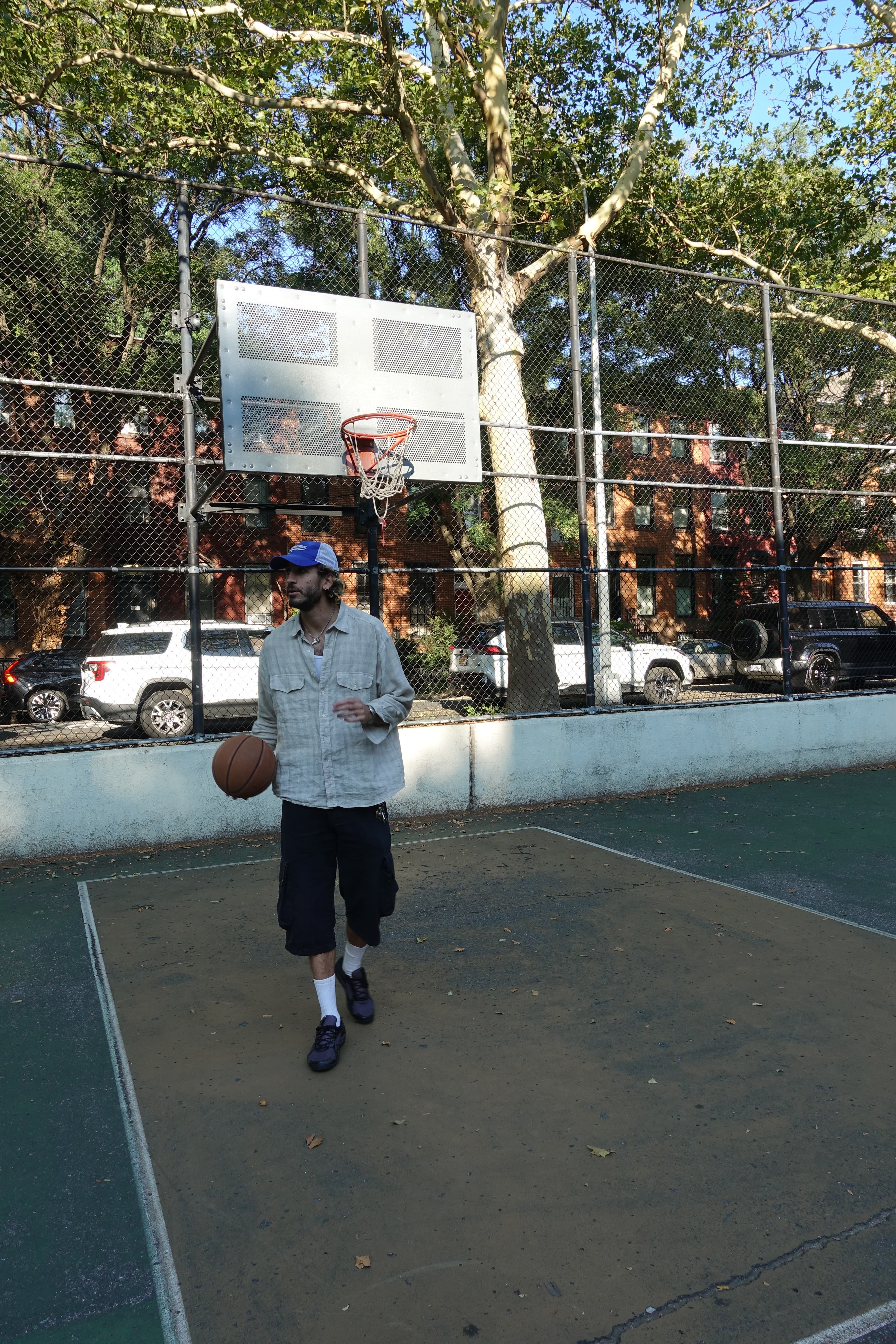
I was soon playing weekly at a park in Fort Greene called Edmonds. There I began to familiarize myself with a rotating cast of characters who have laced up at that court for anywhere from a few weeks to, in Martin’s case, over three decades.
Tall and broad with long arms and a crop of shaggy graying hair, the fixture of Edmonds Playground lives in an apartment adjacent to the court, and peers out the window to see if any qualified hoopers have materialized, only then to saunter out himself. Usually garbed in camo shorts, a graphic tee shirt, and ombre aviators, he arrives with a leather speaker the size of a car tire, blasting exclusively WFMU radio, which can oscillate between talk (“I remember the first time I saw Tom Petty…”), haunting noise music, or, if we’re lucky, surf rock. Parker and I often arrive at the court as a duo, which Martin quickly connected to the name Charlie Parker, the Bird. When we appear, he bellows, “Jazz time!”
Martin has developed a singular game that will see him playing for decades. I have the privilege of matching up with him almost every time we’re on opposing teams. If I don’t get into a deep squat and push him out of the paint before the ball is checked in, he will turn over his left shoulder and shoot a slow-motion fadeaway off one leg with 80% accuracy. If I jump (god forbid I jump), he miraculously holds his release for another second, sending the ball soaring directly into the hoop only once I’ve begun my leap’s descent, helplessly swatting at air. When a game starts to get close, or if a teenager gets under his skin, Martin will cut hard and shoot a surprisingly athletic jump shot, floating laterally across the foul line.
One of the greatest joys of my life is getting to watch a local youth embroiled in the psychological hell of guarding a 59-year-old in a Garfield tee shirt. After bucket number two, another teen will surely call out “Switch!” only to find themselves in the same chamber of torment. Guarding Martin requires a kind of grown-man strength unavailable to anyone under the age of 18. I just barely eclipse the threshold. If I miraculously manage to block Martin’s shot, he grins widely, belting, “Oh, yeah!”
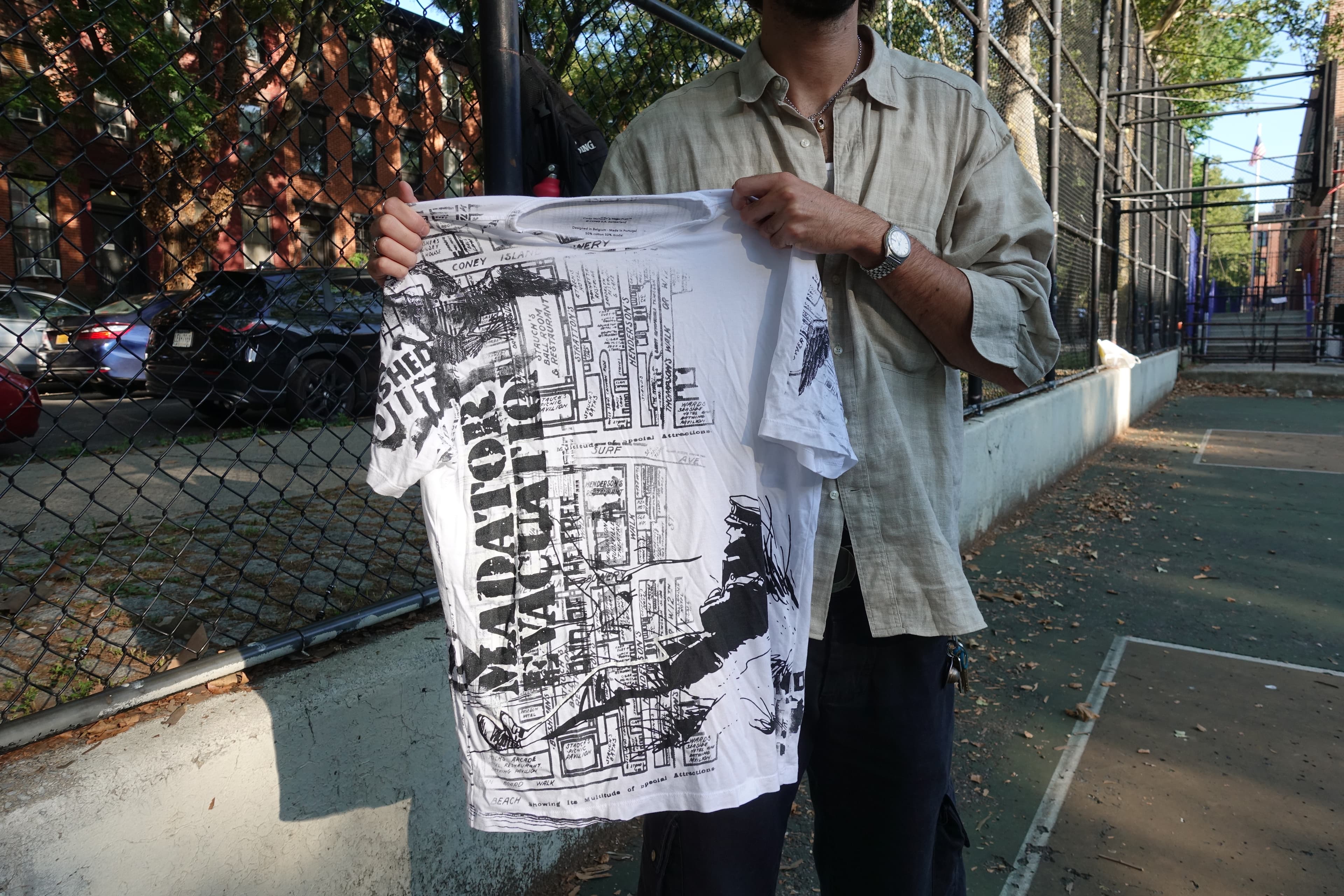
A few months ago, he let me and some friends in on a secret: he had made something for us. I had a spring in my step for weeks, giddy with anticipation. He presented to each of us a one-of-one hand-painted t-shirt, the result of repeated screen prints—a map of Coney Island from a 1903 edition of The Brooklyn Eagle, his renditions of fictionalized anthropomorphic ride names, American iconography—overlaid meticulously and then obscured and revealed by diligent hand-painting. One print reads “MADATORY EVACUATION,” a misspelled reminder of when he purchased the beachside tees last summer at the Outer Banks before a major storm interrupted his yearly sojourn. When a passerby, drawn to the vivid shirts like a moth to a flame, asked Martin if they were for sale, he scoffed—almost as if he didn’t understand the premise. In Martin’s mind, shirts like this cannot be bought; they are earned.
I once caught a glimpse of Martin in his apartment, shirtless and enshrouded by plants, laboriously hunched over a t-shirt. “The act of the physicality of painting is important to me,” he told me later, sitting in the abundantly green backyard of the apartment he has called home since the early ‘90s. I asked him why he still plays so much basketball, and he hinted that there are some hereditary health problems in his family, before offering: “If I didn't play all these years, I think I'd be dead by now.” Quietly, he added, buttoning up why I—with a weak competitive spirit, generously middling agility, and a shaky handle—have dedicated hours each week to this game: “Basketball has helped me live.”