Are You My Mother?
The tooth pain was another reminder of how pregnancy changes you for good, not just for nine months. I had taken for granted decades of uneventful coexistence with my dental architecture before pregnancy's hormonal shift, which moved my teeth like tectonic plates under the fresh pressures of heat and gravity. The dentist told me I would need an extraction. Postpartum is full of bewildering corporeal discoveries like this. You would think after the nine-month odyssey of creating a second consciousness within that your hard work would be behind you. But you would be mistaken.
A whole garden variety of oddities and maladies await you beyond the threshold of giving birth. My feet, for example, have spread an inch or two beyond their former size, making the experience of trying on any of the shoes from my past life a humiliation ritual. Or take the undergrowth of woolly hair that has formed around my temples, curling into wild horns anytime I pull my hair back in search of sensory reprieve from the stickiness of caring for a baby. The British pediatrician and psychologist Donald Winnicott described early motherhood as a kind of necessary mental illness—a period of temporary madness to ensure the process of the mother’s attunement to her baby is healthily underway. No clinician warned that I’d look the part, too.
To navigate this period of intense identity recalibration, I employed the help of a psychoanalyst whom I visited weekly once my maternity leave ended. She mostly listened quietly while I prattled on about the banalities of work and motherhood, and despite the clinical setting, I grew fond of her. Our dynamic resembled the one I shared with my infant son, who was in a phase of bringing over every object he could find and dropping it in my lap for the apparent satisfaction of my mere acknowledgment of it.
“Wow, that is a red truck!” I found myself saying throughout the day.
The relationship with my therapist was much the same.
“Wow,” she might say when I pointed to the speckled bruises all over my arms—the tiny brutalities of my infant son’s pincer grip—“That does sound upsetting.” Someone bearing witness to your experience is a psychically healthy thing, it turns out. Each week I dropped something new in her lap, and she responded in kind.
Around the time of my wisdom tooth extraction, I was having a hard time. I had been putting off the procedure for months because of the problems it asked me to solve: the time commitment, the pressure on our childcare-addled bank accounts, the idea of pausing breastfeeding to pump while high on pain medication. When I finally scheduled the procedure, the conditions were less than perfect: My husband’s work travel hit a particularly aggressive clip, meaning he was away most nights in August. My life had become a tightly wound path between home and the office. Most evenings I careened through the door and into the blur of dinnertime, bathtime, breastfeeding, bedtime. The toothache kept getting worse, radiating along my jaw and up toward my ear. I was perpetually irritable.
I Ubered to my surgery appointment at a Chinatown practitioner who would do the procedure under local anesthesia for a fraction of the standard cost. The doctor was kind and experienced, but I cannot in good conscience recommend witnessing the sights and sounds of someone sawing into your jawbone, even under the numbing agents of modern medicine. A wave of claustrophobic nausea overcame me during the extraction, and left me with that slightly panicked state of disembodiment that reminded me of my C-section. I Ubered home after the procedure to rest, where our nanny arranged to stay with the baby until the anesthesia wore off.
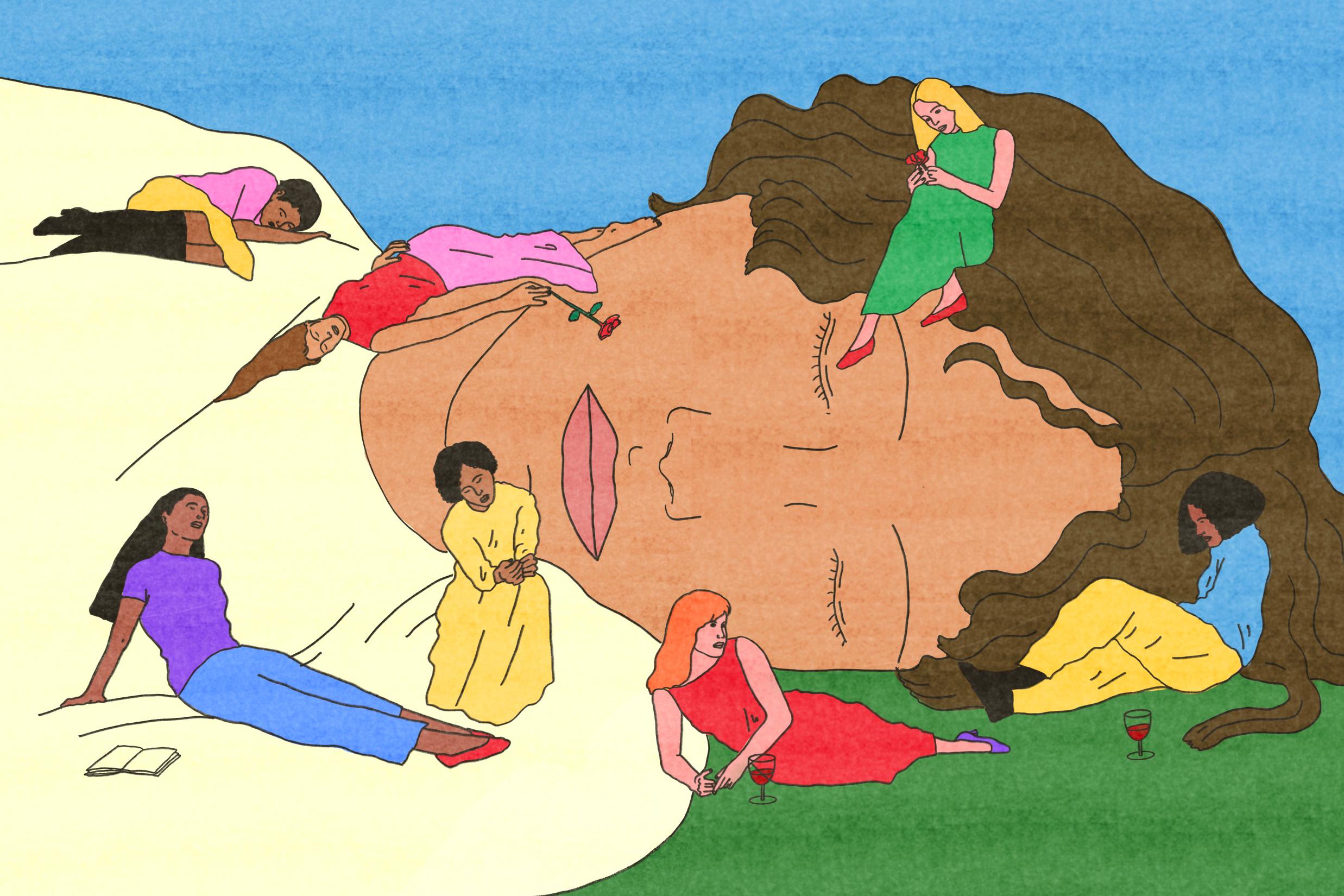
That afternoon, I dreamt powerfully. In one dream, I saw my therapist sitting in a chair above me. She was a warmer version of herself than in waking life, more like a friend. I felt like we were flirting. I saw myself dressed in white, kneeling at her feet, wearing a veil that was somehow bridal and also childlike. I closed my eyes to confess to her, and felt a dozen little kisses, whispery butterfly kisses, brush my face. I opened my eyes to see who was kissing me and was surprised to find she was gone. “It was you all along,” her voice said. It was a lovely dream, and a strange one—amplified no doubt by the oxycodone coursing through my system.
Was I in love with my therapist? Had I seen God? I didn’t know what to make of it, so I decided to do what I always do: I brought the dream to my therapist and dropped it in her lap. “When you start dreaming about your therapist,” she laughed, “that’s when you know it’s starting to work.” She asked me what the dream felt like. “It felt like being taken care of,” I said, “Like being mothered.”
I have a friend who had a baby five months after me. She paced in loops around her apartment many nights, rocking her son in her arms to try to get him to sleep. Her Health App registered it as thousands of steps—this pacing around her apartment—and one night, about four months postpartum, she stubbed her toe in the process. She paid little attention to her injury. She had recently returned to work. The baby needed sleep. She needed sleep. She needed to wake up in the morning to go to work. The baby needed milk. The baby needed sleep. She paced. She woke up, walked to work, and when that was over, she walked home. She paced again through the night. This cycle continued successfully for several weeks until one morning she realized she could not walk. She booked a last-minute appointment with a podiatrist who was horrified by the state of her toe. He scolded her for letting the infection get so bad. He removed the nail clean off her toe and set it in a little cast to repair the sprain, sending her home with a bag of antibiotics. In the shadow of her C-section recovery, she said to me, recounting the story, the mangled toe seemed like a walk in the park.
During my most depleted days of parenthood, after my son is asleep in his crib, when I’m trying to summon the energy to stand at the kitchen sink and unmake the chaos of the evening, I have taken to listening to the archived BBC broadcasts of Dr. Winnicott in the background. There is something comforting about his lectures on “the ordinary devoted mother”; something assuring in his notion of “good enough care.” Maybe it’s because his studies give shape to the work that no one will see, and make real all this time my child surely won’t remember, if I’m doing it right. Maybe that is why parenthood is such a radicalizing, cultish force. Caretaking is work that seems to live in the air. Caretaking is work that, even at the height of its bliss, seems like it might destroy you in the process.
This might explain the existence of the hospital fantasy, a phenomenon that has been documented on Reddit threads and psychology blogs alike, in which the fantasizer, usually an overextended caretaker, often a mother, is struck by sudden illness that arrives like a deus ex machina, freeing her from the demands of everyday life. “Sometimes I hope that I get super sick and have to stay in the hospital for a little while,” one user writes in r/stayathomemoms. “I know this is horrible, but I’m so desperate for a break that I don’t feel guilty about.” A fantasy, like a dream, creates a permission structure for the dreamer to do what in waking life may seem impermissible. When the demands of modern motherhood amount to walking on an infected toe for weeks without noticing, this fantasy does not seem so far out of left field.
Why do we think of our own mothers when we become mothers ourselves? Some psychoanalysts think caring for an infant can dredge up repressed memories of our own infancy, and the love, loss, and anxiety embedded within them. We call out for our mothers anytime the world feels cruel, perhaps to summon all the strength she has cultivated within us. The “internal mother,” Winnicott says, develops through the comfort and care of the external mother—the flesh-and-blood mother, with her hours, days, and years of invisible labor. Then, that comfort becomes an enduring source of “love, protection, and of life itself” for the infant. Joining this legacy of caretaking is a holy thing. It’s when the work of motherhood that came before you makes itself known, showing the extraordinary effort of simply being an “ordinary devoted mother,” a feat of the highest order, tectonic as the teeth shifting in my mouth. Maybe that’s what the voice in my fever dream was trying to tell me—that my mother’s love was still in me, still there to comfort me. “It was you, all along,” the voice said. I heard her clear as day.