Once relegated to the internet’s most private corners, fanfiction is now big business. But what gets lost when our fantasies become someone else’s intellectual property?
By Sennah Yee
Illustration by Stella Murphy
Published
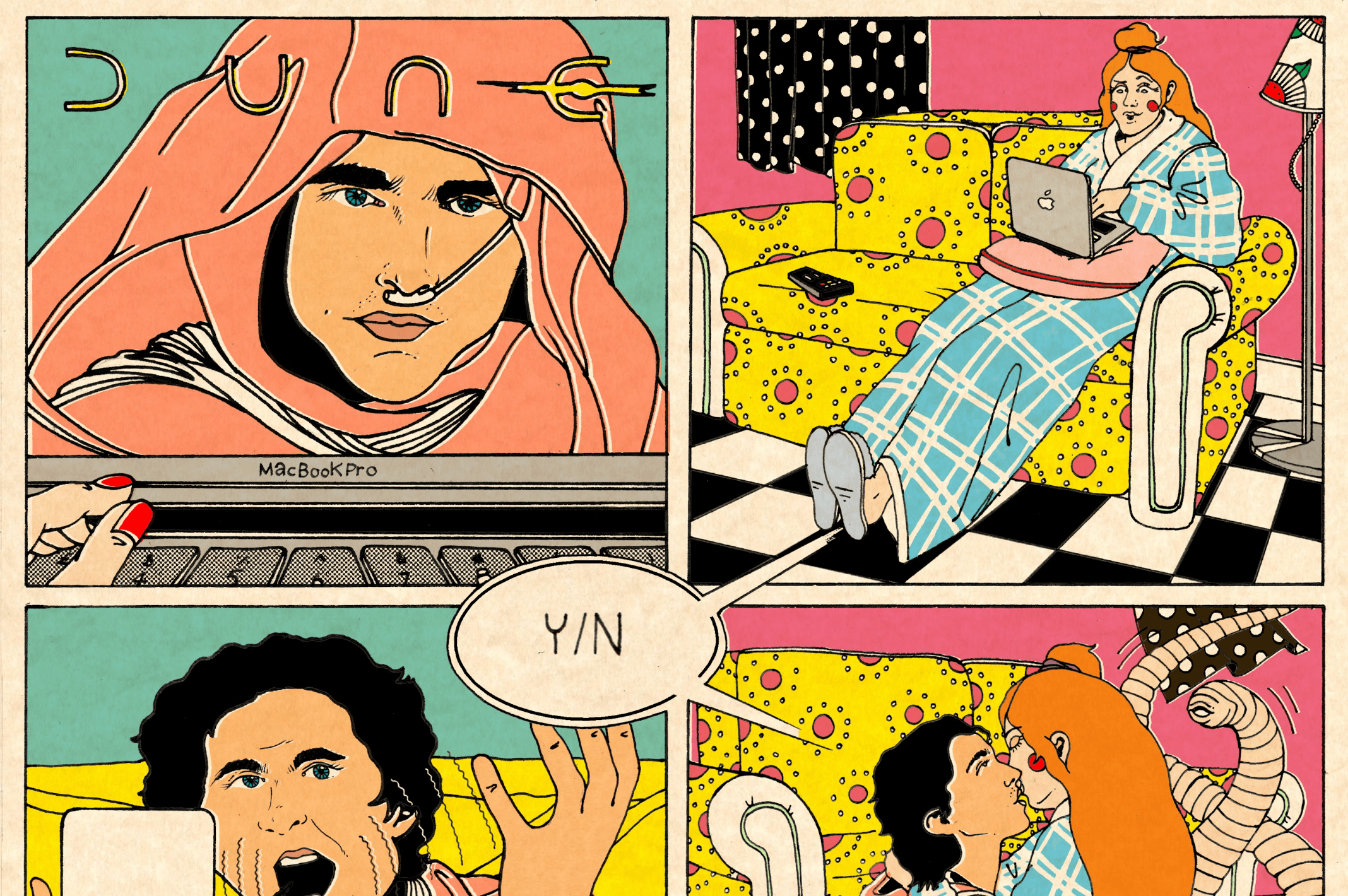
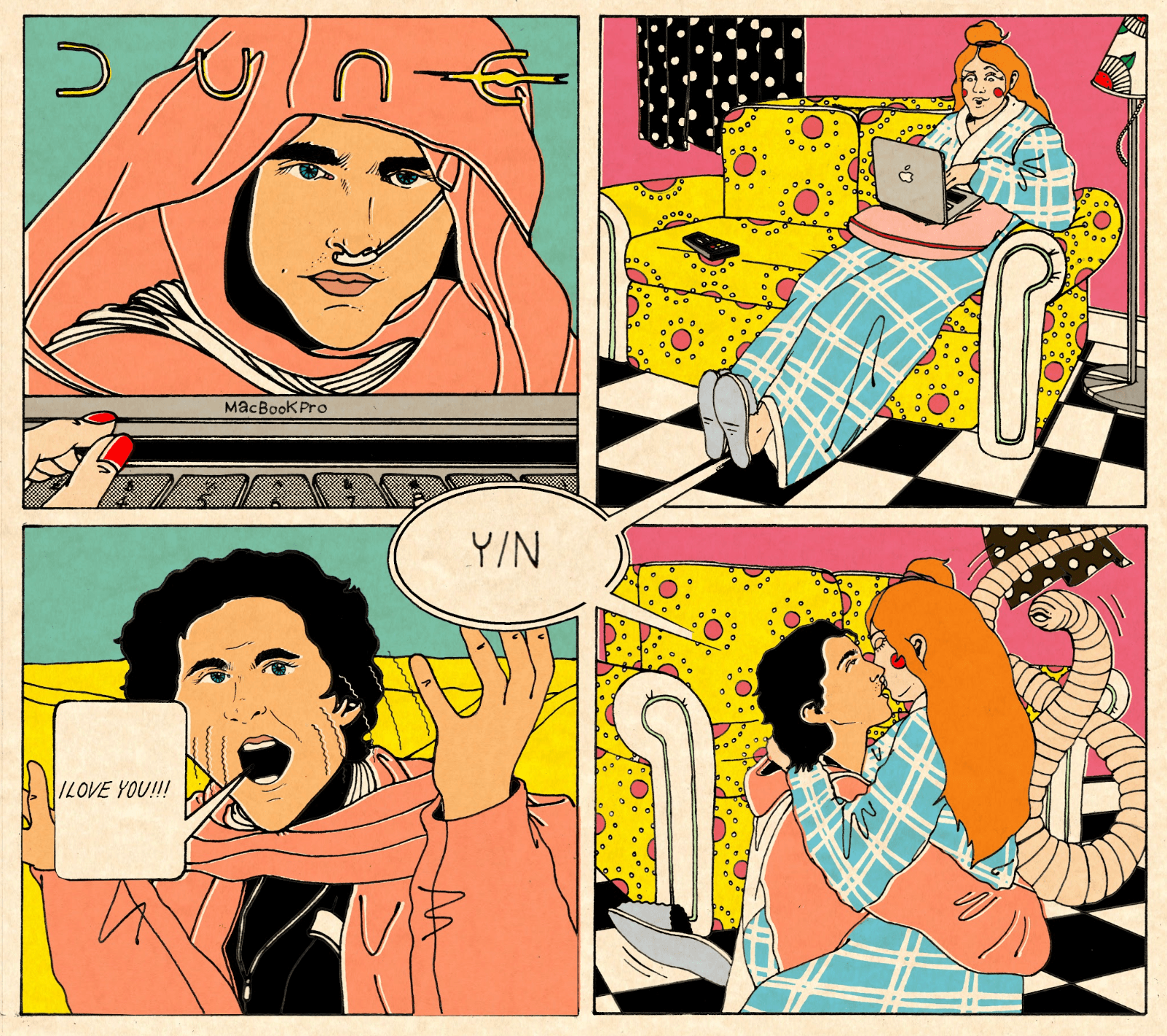
The lead singer of my favorite emo band and the bassist of my other favorite emo band are in rival mob gangs, but they are secretly sleeping together. A Formula 1 World Champion wakes up one day and discovers he has a vagina, and isn’t afraid to use it. Paul Atreides from Dune uses The Voice on you to make you fall in love (and lust) with him. These are only some of the intricate fantasies that the internet’s horny hivemind has conjured, and that I’ve surely been the first in my bloodline to read.
My fanfiction obsession dates back to when I was eight years old, chicken-pecking stories on my family’s desktop computer about *NSYNC and Britney Spears. I made them go on all kinds of elaborate adventures: exploring medieval castles, drinking magic potions, and, of course, kissing each other. I didn’t know I was writing fanfic then; I just knew my favorite celebrities were the perfect launchpads for my fantasies.
I read fanfic on that same desktop computer throughout high school, finding community in semi-private online spaces like LiveJournal and Tumblr. Reading fanfic tagged “PWP” (short for “Porn Without Plot” or “Plot? What Plot?”) was my first foray into queerness, porn, and kink—and while I’d explore these things further by surfing through basic porn websites, fanfic sites like Archive of Our Own offered tags far more appealing in their complexity.
These tags described sex acts and kinks in the same way porn websites did, but they also described niche tropes (think beyond hot stepsisters or repairmen; I’m talking friends-to-lovers-to-enemies-to-lovers-to-a-secret-third-thing) and particular emotional scenarios (hurt/comfort, fluff, or the tension of friends having to share a hotel bed) that made the smut all the more vivid. Even at its most plotless, fanfic inherently has context built into its DNA, because it’s based on pre-existing material.
It got to the point where, as soon as I consumed any pop culture, I’d immediately search for fanfic about it. I loved the world of film and TV, but I felt most seen by their alternate shadow realms, where women and queer people were fantasizing about gender swaps or your mom selling you to One Direction. I told my close friends that I was queer at the end of high school, but I kept the fanfic side of myself in the closet until I was in my thirties. I just didn’t want to open that door.
Fans often try to keep their creations from “breaching containment,” a fandom term for when something niche escapes its fandom space and seeps into the mainstream. It’s also a widely known rule never to share fanfic with the original creators or subjects, though this boundary has increasingly been broken.
What happens when private fantasies go public? They become ridiculed: we’ve graduated from viral BuzzFeed videos of celebrities reading thirst tweets about themselves to promo videos where celebrities are asked about fanfic on camera. Recently, Ferrari and Peroni had Formula 1 Drivers Lewis Hamilton and Charles Leclerc read and guess real “fan story” plots out loud to each other, much to the fandom community’s horror.
On the flip side, these private fantasies have also gone public on purpose: entire films and franchises like 50 Shades of Grey (Twilight fanfic), Heated Rivalry (Captain America/Bucky Barnes fanfic), and The Love Hypothesis (Kylo Ren/Rey fanfic) now exist. Each (allegedly) stems from fanfic but is repackaged as a commodity. The private and the public are blurring together, with fantasies like BDSM and boys’ love becoming more legitimized in mainstream spaces—yet the niche communities that initially dreamt them up are often still mocked.
Many fanfic authors and readers are openly self-deprecating about their niche interests and taboo kinks in their author’s notes or comments, which in turn signaled a subtle shared shame in me. And like many hobbies and interests dominated by teenage girls and women, fanfic is often seen as cringe in its earnest self-indulgence.
In its purest form, fanfic is ultimately unfit for publication by mainstream standards, which is refreshing. People are writing 100-word drabbles or hundreds of thousands of words about their fantasies, whether filthy smut or intricate worldbuilding or both… just to be enjoyed. As Francesca Coppa writes in The Fanfiction Reader: Folk Tales for the Digital Age, fanfic is “made for free, but not for nothing.” It’s hedonistic, cathartic, and all for the love of the game. Creating for and within a community of shared pleasures, free from money, is powerfully anti-capitalist.
Only in this kind of environment can you feel safe to reveal your yearnings, however freaky or fluffy. When I journeyed into the world of Formula 1 fanfic, I wasn’t surprised by all the smut, but I was fascinated by the more mundane fantasies. Some included “Y/N,” which stands for “your name,” so you can insert yourself into these scenarios. Some are simply listed as a series of bullet points or as short as a single sentence (called “imagines”): a driver comforts you with your favorite snacks while you’re PMSing, or excitedly reacts to news that you’re pregnant with his child, or shyly confesses that he was jealous when you were friendly with another driver at an afterparty.
Other “imagines” included a driver asking consent before kissing you, or stopping sex altogether to check in when you used your safeword. These speak to some of our most vulnerable desires for Y/N, which can stand for ourselves, but also for everyone: safety and care.
Some fanfic may escape its enclosures, the door unlocked by a Hollywood exec or a PR firm, while others may remain happily in their homes. At the time of writing, Shoresy, the “other” hockey show, has a small but mighty collection of 178 works on the fanfic site Archive of Our Own. One work writes one of the lead characters as trans; another is a crossover with, you guessed it, Heated Rivalry. The TV show The Shards has only seven works, one of which inserts a gender-neutral, goth reader alongside a supporting character. And imagine my shock when I looked up Wicker (2026) fanfic, expecting a healthy amount of Alexander Skarsgård/Reader basket smut, only to find a single entry. It pairs the reader on a cute dinner date with the weaver (Peter Dinklage), not the woven.
Alas, less than 24 hours after I wrote the last paragraph, my obedient Instagram algorithm feeds me a graphic: a fanfic contest for Wicker. “Write an original erotic story inspired by Ursula Wills Jones’ short story The Wicker Husband.”
I take a closer look: it’s officially sponsored by the Wicker film, the production studio, and Quinn, the latest trendy audio erotica app. “Winning entries will be transformed into fully produced immersive audio stories on Quinn. Winners will receive $10K plus an additional adaptation fee.” Fans, and their fantasies, commodified.
Of course I’ll check out the winners, but I can’t help but feel that the real gems will be the losing entries. The truest fantasies are unpublishable: something, someone you can dream up in shameless specificity. A deep part of Y/N, shared with some—but ultimately kept just for Y/N.