“What’s In My Bag” is the New Still Life
The handbag as a portal into recognition, a mirror of modern identity.
Published
Once upon a time, “What’s In My Bag?” was a glossy feature that existed to flatter a fancy handbag with magazine-driven market appeal. Market editors, art directors, and other magazine staff once collaborated to meticulously stage fashion spreads, curating the ideal contents of a woman’s luxury handbag.
A Chanel flap or Balenciaga City would spill out tubes of Dior lipstick and Moleskine notebooks, arranged just so. The purse was the portal, a symbol of both wealth and taste. But in 2025, the genre has slipped out of the pages of Vogue and into our hands, our feeds, our bedside tables, our TSA bins.
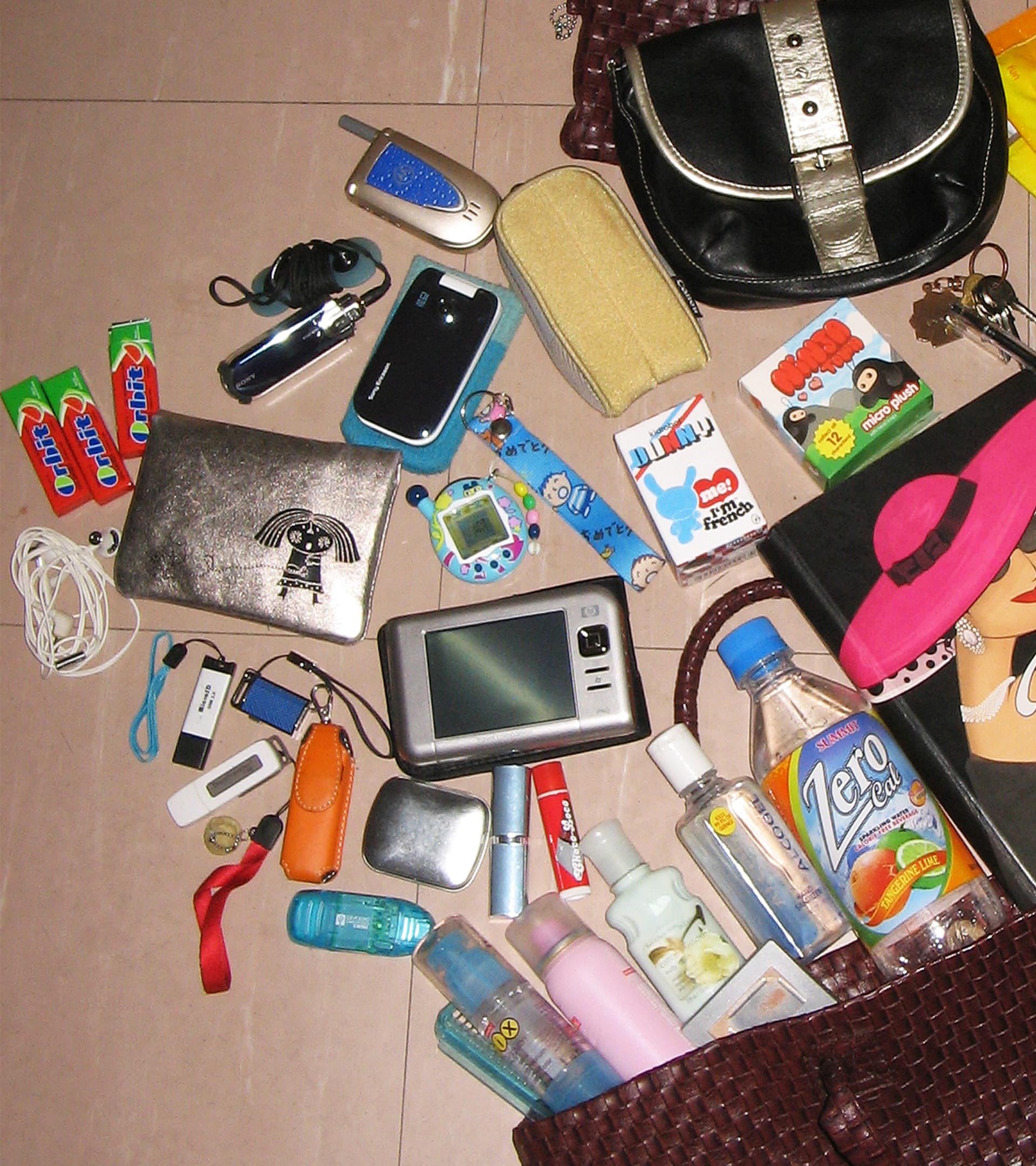
The objects we carry—lip balm, receipts, prescription bottles, Erewhon smoothies—have become more than clutter. They’re cultural signals. Like Dutch vanitas still lifes, these everyday compositions tell us what we value, what we aspire to, and what we can’t control. The messy, intimate scapes of purse portals circulate on TikTok and Instagram in a manner beyond utility. They’re about staging the self.
When Halle Robbe, creator of @girlscarryingshit on Instagram and editor-in-chief of pinky magazine, first started documenting women juggling energy drinks, wallets, and phones, it wasn’t about aspiration. It was about recognition.
In her early 20s, Robbe was grinding through 60-hour workweeks in corporate social media, churning out sterile, brand-approved feeds she didn’t connect with. A former Tumblr girl, she missed the “oddly satisfying” and “weirdly beautiful” images that made the internet feel alive in her adolescence. So she started collecting those moments for herself, snapping photos of objects and, eventually, girls carrying things. “It was comforting to see other girls juggling things and interesting to see how they did it, physically-speaking,” she tells me over email.
One day, she took a photo of herself carrying two Red Bulls, keys, a little black leather wallet, and AirPods, and posted it to her Instagram story. Friends immediately replied: I do this too. That spark became @girlscarryingshit, a project that has since grown into a massive feed of aesthetic but attainable glimpses into everyday life. “Ultimately,” Robbe says, “I think the ‘story’ here is that we all can and should romanticize our lives however we can, because it’s one of the very few free things we can do to take the edge off.”
Robbe notes the difference between what’s in your bag versus what’s in your hands: the bag is passive, enduring, vague; hands are active, fleeting, precise. A purse might reveal an emergency tampon; a hand reveals a coffee, a MetroCard, and the fact that you’re late. The intimacy isn’t in the product, but in the posture of being caught mid-juggle.
Trend forecaster Anu Lingala frames this shift within a macrotrend she calls ‘radical realism.’ After a decade of hyperstylized Instagram minimalism, audiences now crave intentional imperfection: bedside tables stacked with water glasses, TSA trays lined with snacks and chargers.
“The rise of Tiktok, fueled by Gen Z, correlated with the rejection of perfection and the embrace of what felt more real, messy, slightly unhinged, and widely relatable,” says Lingala.
While these images are messy, they’re not too messy. “Nikita Walia describes this as ‘artisanal reality,’” Lingala explains. “It’s a deliberately constructed form of reality designed to read as human in an increasingly optimized visual culture. It’s not anti-aesthetic. It’s anti-synthetic.”
This is why even curated chaos resonates. A TSA bin stuffed with Celine sunglasses and a pack of gum tells a story about leisure and mobility. “While outfits can often be easily duped at a lower cost, travel, and experiences more broadly (dining out at restaurants, attending concerts and music festivals), require a minimum spend that conveys disposable income,” continues Lingala. In this way, travel, she says, has become one of Gen Z’s most aspirational markers—it costs money, but more importantly, it costs time. Posting your tray at JFK becomes shorthand for having both.
They could be defined as “cloud 9” objects; these new object-scapes are cinematic curations of the mundane that evoke the dreamy ease suggested by the old phrase “on cloud nine.” A grocery basket with oat milk and flowers, or a nightstand stacked with three books and a candle, isn’t remarkable on its own—but arranged this way, it radiates an aura of blissful effortlessness.
Journalist Maria Santa Poggi points out that today’s sharing culture is less about projecting a purely aspirational image and more about striking a balance with relatability while fostering stronger parasocial bonds between online creators and their followers.
Audiences want both the dream and the everyday mess, because it feeds into what she calls the “effortlessness effort paradox.” What looks spontaneous and casual is in fact carefully staged, inviting you in while still nudging you to covet the Glossier Balm Dotcom or Le Labo candle in the frame.
That balance, between mess and aspiration, candid and curated, is why people love Robbe’s feed. “There are photos on my page that feature literal garbage with good lighting,” she says. It’s aesthetic but attainable, a collective game of I spy. The point isn’t to own a Prada wallet, but to find your light.
And yet, brands circle. Both Poggi and Lingala note how easily this visual language slides into marketing. Flat lays, after all, are nothing new—they’ve anchored catalogs and magazines for decades. But now, instead of a perfect spread of products, a soft-sell comes in the form of a bedside table shot: your iPhone charging next to a Diptyque candle, maybe a half-drunk glass of wine. It’s marketing by way of intimacy.
“Since the rise of the millennial multi-hyphenate and the gig/freelance economy, lines between brand storytelling and entering the cultural chat are quickly blurring due to influencers having more legitimate influence over people than our politicians,” says Poggi.
The fascination with bags and their contents has always been gendered. To peer into a woman’s purse is to glimpse how she cares for herself—and implicitly, how she cares for others. Robbe calls this “a very girl-coded thing.” A receipt for snacks, a bottle of Advil, a spare tampon tucked next to lip gloss: these are not just products. They’re traces of caretaking.
At the same time, there’s relief in seeing messiness made visible. A nightstand cluttered with chargers and medications feels more honest than a luxury handbag flat lay. As Robbe points out, if someone looks like they’re carrying nothing, “I know there’s someone just out of frame holding their shit.”
Lingala predicts the next wave will hinge on what she calls ‘aspirational humanity’: as AI-generated images flatten culture, audiences will crave proof of human touch. That could mean more intimate storytelling about objects: the origin of a bag, the story of a bracelet, the quirks of a favorite pen. It could also mean celebrating not just the polished flat lay but the awkward spill, the lip gloss rolling under the car seat, the book bent at the spine.
The “What’s In My Bag” genre isn’t going away. If anything, it’s expanding into creative directions that will make room for humor, vulnerability, and new forms of soft-sell marketing. The question is less “What’s in your bag?” and more: How do your objects become evidence of who you are, and how you want to be seen.
The beauty of this format is that it’s both personal and shareable—making it ripe for a new kind of gift guide. If Dutch painters used fruit to comment on mortality, we use tote bags, snacks, and skincare to comment on our lives online.