Sillage: The Smell of Absence
Exploring how smell lingers, from olfactory afterimages to breadcrumb trails of desire.
Published
The Stink is a column that analyzes the desires and cravings evoked by scents, particularly those of New York City.
In perfumery, sillage is a term that refers to the cloud of fragrance that follows after its wearer has passed by. Borrowed from the French, the word was originally used to describe the wake of a ship—the disturbed path of frothing water left behind by, say, the ferry departing Rockaway toward the vertiginous shimmering walls of Manhattan’s financial district. A sillage can be a torturous phenomenon, the persistent rankness of an off-putting stench that seems to never leave, or the last floating particles of a delicious one that is sadly soon to disappear. It’s sexy, it’s mysterious, it’s primal.
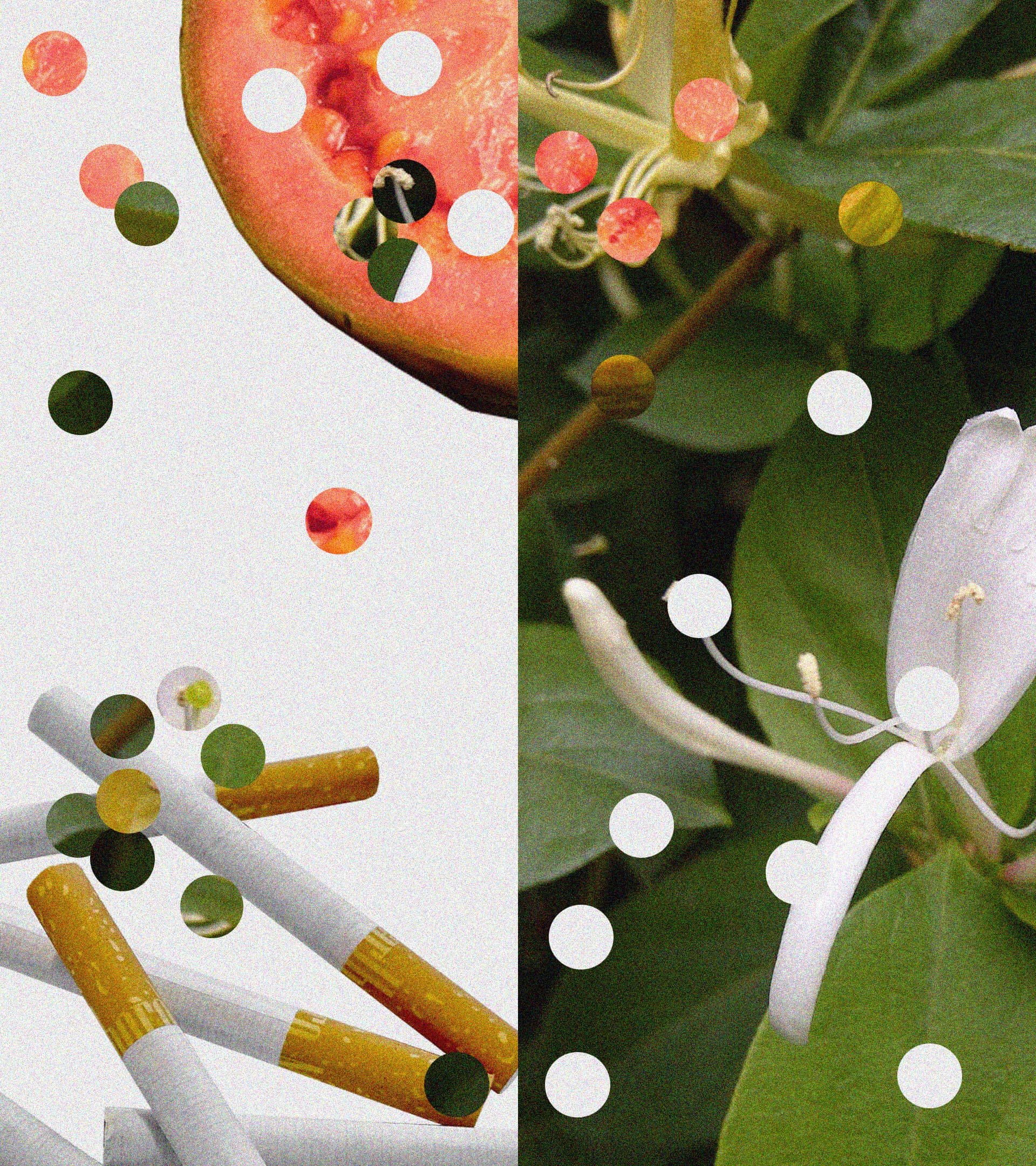
Sillage is not necessarily longevity (how a scent remains potent), transference (when scent clings to another person or object), or even projection (how far a fragrance radiates), though these elements can come together to support it. Sillage floats slowly as one walks, and remains in a room after their departure. It’s a second wave. It’s the smell of absence. A strong enough sillage, be it perfume, body odor, or anything else, creates a double-take effect. For example, quickly passing someone on the city streets, only to find yourself in a delayed cloud of fragrance that drags the snout of your face backward to follow the narcotic spell of their honeysuckle perfume. Similarly, returning home to be greeted by your roommate’s recently sprayed cologne signals that he has just left, and you may now strip naked and blast your music.
When someone smoking a cigarette swishes past you on the Manhattan streets, a warm, cool, sooty trail follows behind them, even slightly after the last curls of smoke have disappeared. In Los Angeles, the smallest hint of a smoker’s sillage will grab attention—either for the provincial opportunity to scold, or the secret desire to look around and light up. A regular smoker can toss their jacket over the back of a chair, and everyone at the dinner table is gifted with the smoky obituary of their most recently smoked cigarette, and the fading memory of all those that came before it. In high school, as teenagers, my friends and I would cover ourselves in body spray or perfume to hide the cigarette smoke from adults, only further accentuating our robust trail of smells.
Another primal example of sillage is human-to-human: the beast with two backs, post-coitus. After a sexual partner leaves our home, their presence persists psychologically and olfactorily. A one-night stand is exciting, heightening all the senses into one moment and often leaving behind some persistent cologne or the suspended shock of an unfamiliar body odor, good or bad, in the air. After spending a long weekend in your bedroom, overdosing on your boyfriend, you revel in the trace he left lingering in the air after his departure. This is sure to dissipate. Perhaps we don’t even notice it while it’s still floating around and we’re high on the fumes, until later that night, when we’re forced to bury our face in the pillow they slept on, or hold their hoodie to our nose if we’re lucky enough for them to have left it.
Danielle Prijikorski, a family friend and painter I’d met during visits to the South of France, and haven’t seen in far too long, has an incredibly distinct scent. I don’t know what perfume she wore, but it smelled of sweet myrrh, vanilla, and sandalwood. This warm blend mingled with her cigarette smoke and rolling tobacco, underpinned by the faint-yet-deep, muffled tartness of oil paint, a scent imprinted into her olfactory DNA over time. It all came together to create something that was not only unmistakably her but was also rich and weighty enough to hang around behind her in the air as she moved. It would loiter around a patio she’d been smoking on or a café she had just left. If you exchanged a long enough hug with her, it followed you around like an imaginary friend.
My body temperature runs hot, and I’m quite wasteful, so I tend to demand even a little sillage from whatever I’m wearing, whether through chemistry or heavy-handed application. But some fragrances are designed to create sillage. The concentration of fragrance oil is often a key factor in sillage. An Extrait de Parfum has the highest concentration, followed by Eau de Parfum, Eau de Toilette, and finally Eau de Cologne, which has the lowest concentration.
Just about any fragrance by Orto Parisi leaves behind a Pepé Le Pew scent cloud, from the dense earth and smoking woods of Terroni to the creamy, feminine overload of animal musks in Seminalis. Jungle Jezebel is Sarah Baker’s notorious and rambunctious ode to the drag performer, Divine. It’s a cocktail of tropical fruits, white florals, bubblegum, and fecal matter that will follow you around like a loud, annoying slut. Au Coeur du Désert by Tauer creates an intoxicating dusty cloud of heating spices and amber. Tilia by Marc-Antoine Barrois is an expensive, girly, and carefree bouquet that dominates the room like an elegant jackhammer. I could go on and on. There are so many sillage-forward fragrances in every corner of the market: Kouros (previously mentioned in The Stink), Baccarat Rouge (jump scare), Pipe Bomb Pink by Blackbird, anything by Amouage, just about anything by Kilian, Fierce by Abercrombie & Fitch—the list goes on. Beyond the notes, what empowers the wearer is the persistence of these scents and how they boldly or nonchalantly extend the duration of one’s presence.
The desire to be remembered is very human—by our work, our love, our deeds, our style, our flavor, and, yes, our smell. And it’s just as fulfilling to our creative and evolutionary selves to remember someone else, to hold their essence clearly in our mind. When I was young, I used to spray one fragrance on the front of my body and another on the back, because I thought this would create a “hate to see you go but love to watch you leave” experience for... men, ultimately. I wanted to further design the experience of my interactions. Some people enjoy sculpting their sexuality into a hard-to-get and hard-to-forget beauty, which the sillage of a fragrance lends itself to, mimicking nature’s existing smellscape of pheromones that create the chase of desire. There’s also an aspect of dominance to sillage. The primal impulse to piss all over the sidewalk in hopes of marking one’s territory is another part of nature that perfumery casually enables like an ethological pastiche. Seduction, territorialism, desire, and repulsion are all tied up in this sexual blur.
Memory itself is a sort of mental sillage, an invisible emotional trail, an olfactory afterimage that leaves a deep mark as we experience transition, loss, or euphoria. Long after a loved one dies, a passing smell or quality of light and temperature can make us temporarily experience their sillage, as if their departure wasn’t so far away. An old lover, or abuser, or both, can haunt us in the passing smell of hair gel. The smell of baked pie filling the kitchen makes us children. A platter of smoking fajitas being carried across a restaurant to a table none of us would like to be sitting at makes us tap our feet and look around for our waiter. And as autumn approaches, quieting Earth’s noise, summer begins to evaporate. The circus of smells—once accentuated by the hot-cooker of New York City pavement—is dying down, soon to be snuffed out by winter’s Capricornian architecture. But in this brief moment, while the last of summer’s heat is leaving our skin, it lingers in sunny corners of our apartment or by the hotdog stands in Central Park. Is it a smell, a memory, or both?